2026 Commercial Lighting Rebate Outlook
Industry thought leader Craig DiLouie details the various opportunities that still exist in the rebate space.
By Craig DiLouie, LC, CLCP, Education Director, Lighting Controls Academy
The commercial lighting rebate outlook is strong for 2026, with widely available rebates covering all popular categories of LED lighting and lighting controls, including networked lighting controls. (DiLouie’s full article can be found here.)
Overall, 2026 marks a year of evolution for programs as they adapt to declining lighting energy savings due to LED market saturation. Average rebate amounts per LED product significantly increased, particularly for higher-energy-saving products. Some programs are shifting from incentivizing products to energy savings. More programs recognizing LED-to-LED upgrades were introduced.
On the lighting controls side, average rebate dollars per installed solution generally increased in 2026. Midstream programs increasingly recognize integrated lighting controls as a method of maximizing LED energy savings. Prescriptive networked lighting control rebates are also growing as programs continue to shift from custom to prescriptive rebates, simplifying adoption.
“The biggest thing lighting practitioners need to understand is that rebates still exist,” said Leendert Jan Enthoven, President of BriteSwitch, a rebate fulfillment firm. “We hear from a lot of people who assume incentives have gone away, but the data does not support that. There is still a strong opportunity to help customers reduce project costs and lower their energy bills.”
As AI infrastructure/data centers and meta projects continue to come online, rising demand for electric power is leading to cost increases. According to the U.S. Energy Information Administration, average commercial electric rates increased roughly 7 percent in 2025, with some regions as high as 29 percent. This enhances the value of lighting upgrades, including lighting controls, with rebates maintaining their important role in reducing initial cost and thereby helping projects get approved.
This article evaluates the 2026 commercial lighting rebate outlook based on data provided by BriteSwitch’s RebatePro for Lighting North America database, examines opportunities for LED lighting and lighting controls, and offers insights into how rebate programs are evolving as LED adoption increases.
Rebate Review
Utilities and energy-efficiency organizations offer rebates as an investment in reducing electric demand, thereby avoiding the typically higher cost of acquiring new generating capacity. These programs have traditionally placed a heavy focus on lighting as a source of high-volume, low-cost energy savings and are primarily targeted to existing buildings. There are generally three types of rebates:
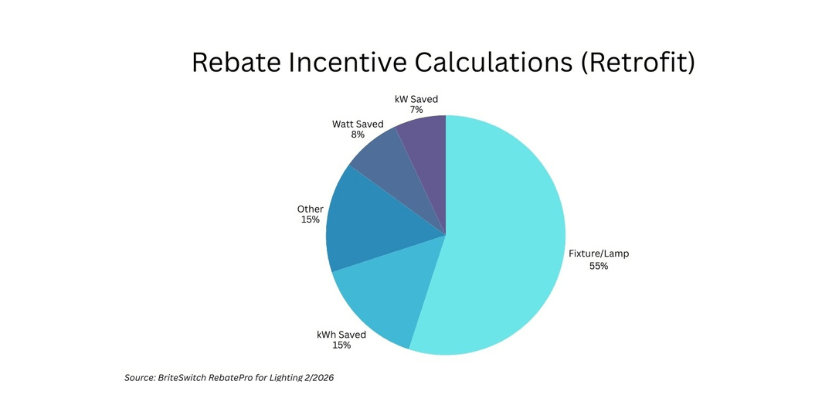
Prescriptive (downstream): This type of rebate often offers a financial reward for each qualifying product installed in an approved project, typically paid to the owner. This is the most popular rebate type. In 2026, more programs started to shift from rewarding installed units to W/kWh saved, similar to custom rebate programs but without the usage modeling and verification those programs typically require.
Point-of-sale (midstream): These are simple, instant rebates realized at the point of sale (e.g., distributor). About a third of utilities offer point-of-sale rebates with a typical focus on common lamps and luminaires, with some incorporating integrated lighting control options.
Custom (downstream): These are typically used for innovative projects that push the boundaries of prescriptive rebates, providing cash rewards based on various metrics, most commonly kWh savings. Modeling of the projected energy usage and verification of those projections are both required for rebate eligibility.
While custom and prescriptive midstream (instant) rebates are available, prescriptive downstream rebates are the most popular and the focus of this article.
2026 Rebate Trends
Looking at the BriteSwitch Rebate Pro for Lighting rebate database for 2026, we can identify several notable trends for prescriptive commercial lighting rebates.
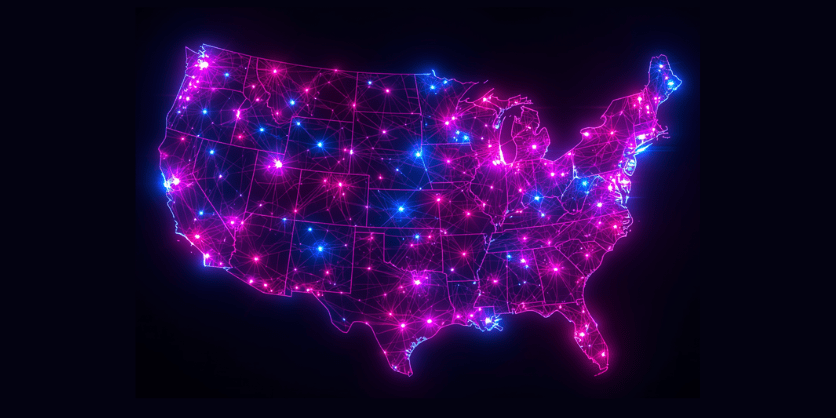
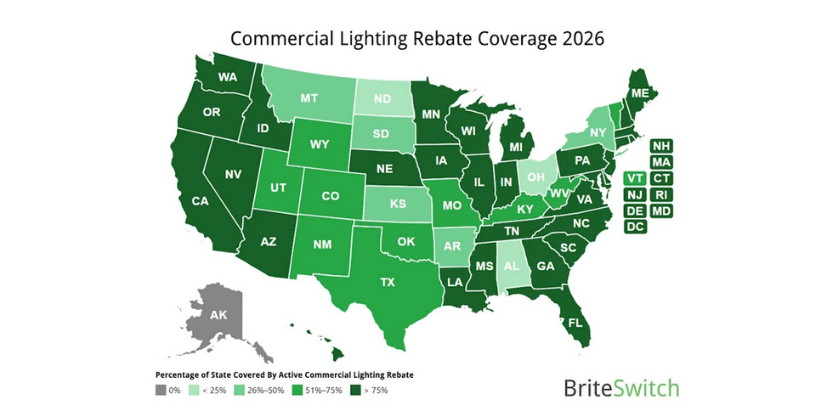
Rebates continue to be widely available. According to BriteSwitch, about 75 percent of the United States is covered by active commercial lighting rebate programs. While slightly lower than in 2025 (77 percent), robust availability of rebate support for lighting and control upgrades continues.
Interestingly, New York State ended its commercial and industrial lighting incentives at the end of 2025, making it one of the few large markets without a traditional lighting rebate offering, although some lighting control rebates are still available.
Rebates for some LED product types have significantly increased in 2026. LED market saturation has negatively impacted demand for commercial lighting rebates. In 2024-25, programs responded by offering substantial bonuses to entice the many legacy lighting holdouts in the market to switch to LED. In 2026, 7 percent of programs began the year with a bonus already in place, while others have increased individual incentives with substantial increases in rebate dollars.
Average rebate amounts increased 2 percent in 2024 and 3 percent in 2025, likely due to inflation. In 2026, rebate amounts rose an average 17 percent across all product types. The allocations are strategic, with the largest jump, over 30 percent, for products replacing HID luminaires, such as pole-mounted area lights, parking garage lights, and wall-mounts, as these conversions are likely to deliver the highest energy savings to the rebate program. Horticultural lighting is also increasingly incentivized, with a growing number of prescriptive rebates.
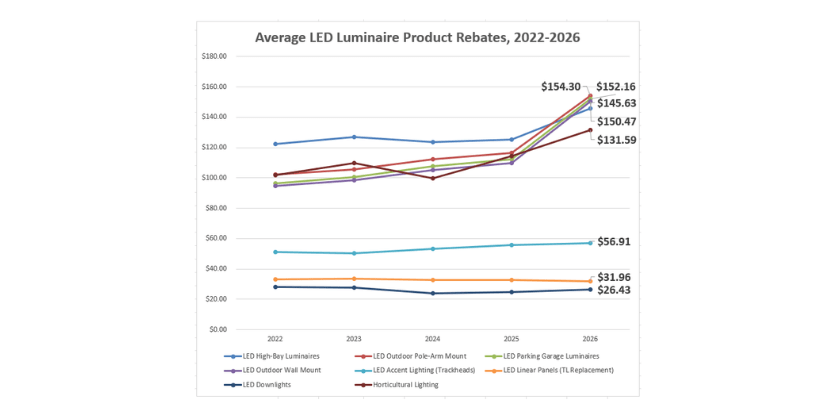
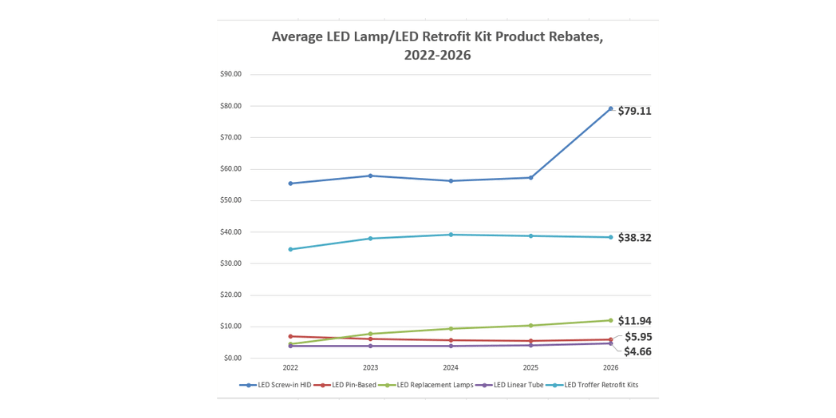
Commercial lighting rebates are evolving to accommodate the LED era. Rebate administrators are caught between increasing need to generate energy savings and diminishing savings from the traditionally dominant lighting category. In response, rebate programs appear to be strategically enhancing average rebate dollars for high-impact options and beginning to sunset mature options that produce a lower return. The number of prescriptive programs rewarding installation of LED PAR lamps, for example, dropped about 13 percent in 2026; downlights, 11 percent; and TLED lamps, 8 percent, according to BriteSwitch.
Rebate programs are also more strongly focusing on the market opportunity for LED-to-LED upgrades and system-wide energy savings. In 2026, 22 percent more rebate programs reward LED-to-LED upgrades, making this an emerging trend, as less than 10 percent of programs overall do so. When a prescriptive rebate is not available, a custom rebate may be offered, however.
Meanwhile, 6 percent of rebate programs shifted from basing their prescriptive rebates on a flat per-installed-product cash reward to incentives based on energy savings, such as watts reduced. This combines the innovation and flexibility of custom rebates with the relative simplicity of prescriptive rebates. It rewards high-efficiency solutions in lighting designs to right-size for appropriate light levels rather than simply replacing luminaires on a one-for-one basis. Some 45 percent of rebates have now shifted from the per-unit approach to focus on energy, power, or other metric, according to BriteSwitch.
States implementing fluorescent lamp bans may still offer opportunities for LED upgrades. Ten states have passed laws banning or restricting the sale of fluorescent lamps, joining Canada, the European Union, and the United Kingdom. Depending on the state, these rules are going into effect between 2024 and 2029.
“We have not seen a consistent pattern in how that affects rebates for fluorescent-to-LED conversions,” said Jan Enthoven.
For example, Hawaii, where a fluorescent lamp ban went into effect January 1, 2026, is sunsetting incentives for fluorescent replacements. Oregon, where a ban went into effect in 2025, is only offering rebates for fluorescent upgrades when paired with advanced lighting controls. Other states such as Maine and Colorado, however, are still offering rebates for TLED, troffer, and other replacement options.
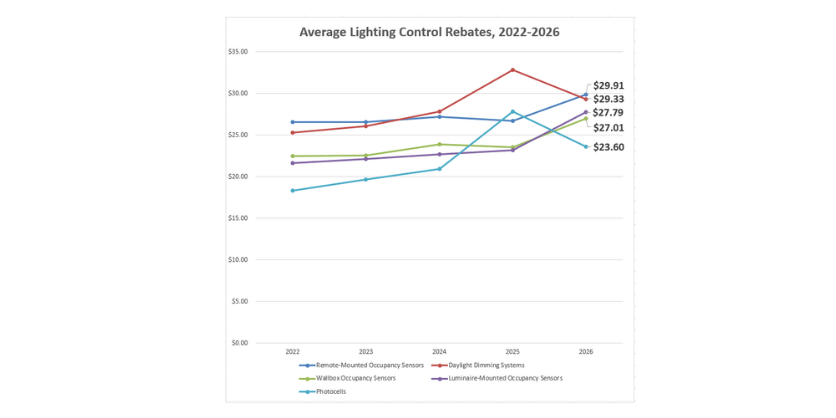
Lighting control rebates remain widely available and substantial, and they are increasing. In most of the United States, if a lighting rebate is available, a controls rebate is available as well. Historically, these rebates have been consistent and lucrative, positioning lighting controls as an attractive upfront addition for lighting upgrades. The most popular rebates cover remote-mounted, wallbox, and luminaire-mounted occupancy sensors; photocells; and daylight dimming systems. In 2026, average prescriptive rebates increased 12-20 percent in several of these categories, a sign of program focus on leveraging controls to maximize energy savings.
In 2025, lighting control rebates were being positioned more prominently in rebate catalogs, with some programs requiring control of LED luminaires in order to qualify for a rebate. In 2026, the number of programs adopting this approach did not significantly increase, but prevailing market forces, higher demand for energy, smaller energy savings opportunity in the lighting category, point to growing importance in the future.
In 2025, integrated control options began appearing in midstream (instant prescriptive) rebate programs. In 2026, this trend is continuing.
“When controls are included in midstream programs, the structure is usually straightforward,” said Jan Enthoven. “We typically see one rebate for a standard fixture, a higher rebate for a fixture with integrated controls, and then another tier for advanced controls like networked controls or luminaire-level controls.”
Networked lighting control rebates continue to grow in availability. Networked lighting controls (NLCs) are intelligent systems in which devices are connected within a network to enact control strategies. The flexibility of this type of system can produce substantial energy savings, making it attractive for adoption by rebate programs, while availability of usage data can lead to non-energy benefits.
In 2026, nearly 200 commercial lighting rebate programs are offering dedicated rebates for NLC, while hundreds more would consider them under their custom incentives. This is a 7 percent increase over 2025.
“We are seeing more of these rebates integrated into prescriptive programs and calculated on a per-fixture basis,” Jan Enthoven said. “That makes them much easier for lighting practitioners and end-users to understand and sell compared to more complicated custom structures.”
The Rebate Process
Rebates take time and effort, but the results can be lucrative as they offer a potentially substantial sweetener for lighting and control upgrade proposals.
Understand the rebate program. Rebate offerings vary across program territories, so it is necessary to understand the technical requirements, application process, pre-approval timeline (if applicable), and other requirements for rebate award for each program. Note that some manufacturers offer support in identifying rebate programs.
Determine if rebates are applicable. Evaluate the potential impact of rebates on sales and include in proposals if applicable to the project. Monitor programs for changes in policy changes and rebate offerings.
Manage risk. Rebate applications may not be approved or may award a smaller amount than expected. Customers should be educated so they have appropriate expectations..
Pre-approval is often required. The rebate program may require that a project be approved prior to installation. Failure to adhere to this guideline can result in rebate forfeiture.
Select qualified products. Most rebate programs require lighting product listing in the DesignLights Consortium’s (DLC) Qualified Products Lists (solid-state lamps/retrofit kits/luminaires, horticultural lighting, and networked lighting controls). Standard lighting controls generally require minimal qualification beyond core function.
Inspection may be required. Onsite or virtual inspection may be required to verify product installation and operation. Documentation detailing the installation may also be required. Some programs may require measuring and monitoring to capture and validate energy savings, particularly for custom rebates.
Put Rebates to Work
For decades, commercial lighting rebates have offered a powerful incentive for buildings owners to adopt energy-efficient lighting and controls. While rebates require effort and pose a degree of risk, building owners have tapped them to help fund installation of new lighting and controls. And while LED market saturation has impacted demand for lighting upgrades, its effect on the overall availability of rebates is minimal.
The overall outlook for commercial lighting rebates in the U.S. in 2026 is strong, with widely available rebates supported by freely available, detailed listings of qualified products. These rebates are particularly attractive for projects involving solutions that incorporate lighting controls, including integrated and networked lighting controls. Rebates can provide an effective way to capture lighting upgrade projects as LED adoption increases.
About the author
Craig DiLouie, LC, CLCP, is Education Director of Lighting Controls Academy. He has provided technical writing and consulting services to organizations such as IES, NEMA, NALMCO, NAILD, New Buildings Institute, NEEA, U.S. Department of Energy, and other industry-leading groups.