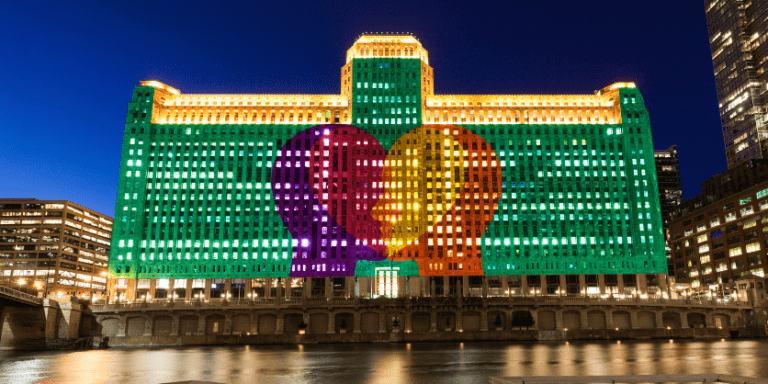
LEDucation 2026 Trend Report
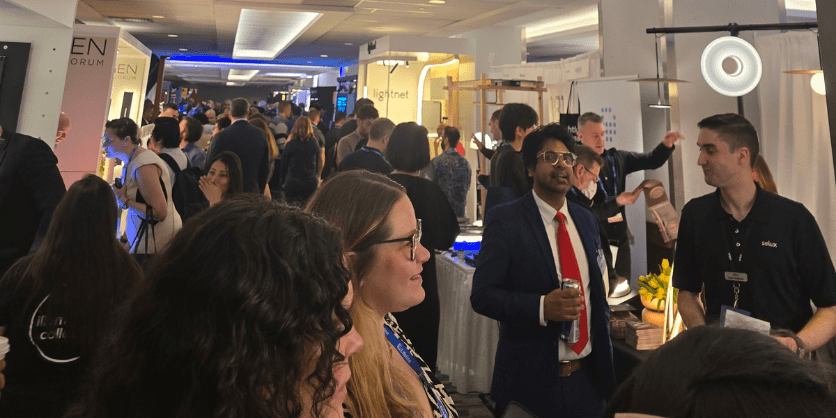
There were so many sound-absorbing lighting fixtures at LEDucation, you’d have thought the exhibit halls would be quiet — but even the best acoustic properties were no match for the buzz from the enormous crowds.
What was this year’s edition of LEDucation like? Well, if you couldn’t attend Light + Building in Frankfurt last month, there were numerous European manufacturers unveiling their latest designs. If you were looking for advances in lighting technology, you’d have found some worthy introductions. And if you were on the lookout for miniaturization of fixtures and more discrete profiles, there were plenty.
What was more remarkable from a trend standpoint was the proliferation of lighting fixtures with sound-deadening features. Up until this year’s edition of LEDucation, there were maybe half a dozen exhibitors offering “acoustic” lighting fixtures. (For the uninitiated, the term “acoustic” refers to a material – typically polyester acoustic felt known as PET – that helps absorb sound.)
For example, domestic manufacturer LightArt – whose parent company 3form was acquired by ceiling and wall systems provider Armstrong World Industries two years ago – is one of the pioneers of the category and has shown its line of acoustic lighting products at LEDucation five times. At this year’s show, a lot more companies joined the category.
Acoustic lighting started as a solution for dampening sound back when open floor plans replaced cubicles in offices. Later it gained popularity in restaurants that needed to fit as many tables as possible in a small space. More recently, hotels have been installing acoustic lighting pendants as well as ceiling and wall panels to help reduce echo and background noise that interfere with guests’ enjoyment of lobby lounge areas.
I’m not sure what is behind the sudden proliferation of acoustic lighting fixtures at this year’s show, but they were literally everywhere.
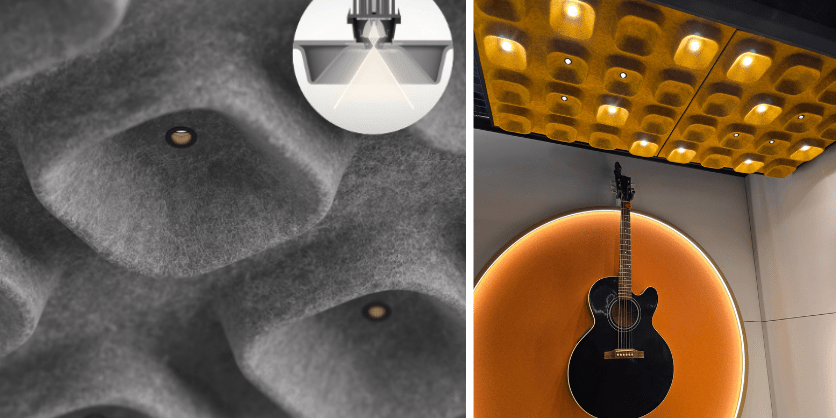
Intra Lighting showed the newest version of its Pyrymyd acoustic ceilings which also provide glare-free light. The Bartenbach LFO version illuminates a space without the light source being seen, while DECO features visible light patterns. The Verso version combines both LFO and DECO optics to allow for switching between different lighting scenarios and can be ordered in 15 colors. A key feature is the unique shape, which reportedly increases the surface area by 60%, making sound absorption even better. The acoustic panels are made from up to 60% recycled material and are 100% recyclable at the end of life. Based in Slovenia, Intra Lighting has several international offices including Pennsylvania.
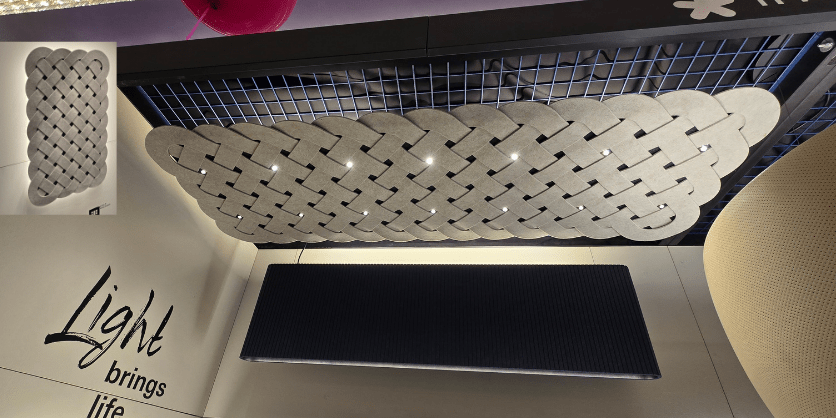
Intra Lighting’s Trenza is a sound-absorbing system consisting of stripe modules that are interlocked for a woven effect. It can be suspended like a linear pendant or fastened to a ceiling or wall and backlit. Made from up to 60% recycled material, the acoustic panels are 100% recyclable at the end of life.
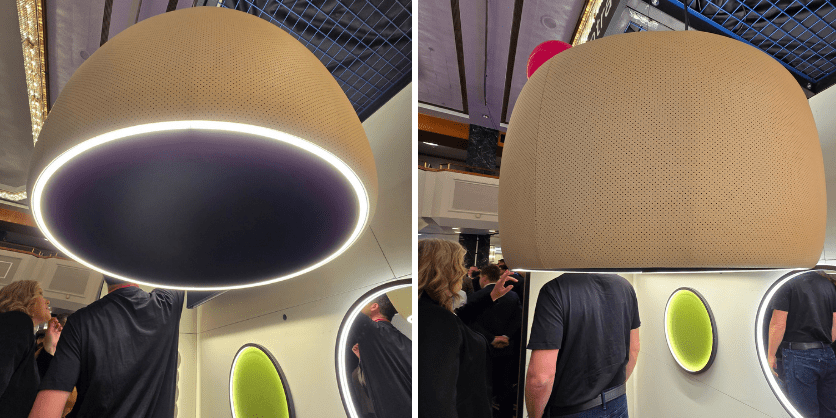
The Black Hole dome (shown here covered in one of the available high-end vegan leather acoustic fabrics) by Intra Lighting is so named for its dark interior — the illumination comes from a circular LED edge treatment on the dome’s perimeter instead of directly from the middle of the fixture. A Bluetooth speaker can also be incorporated into the Black Hole pendant.
Armstrong Integrated Lighting – a new lighting initiative within Armstrong World Industries that leverages LightArt’s capabilities under the AWI portfolio to deliver fully integrated lighting solutions aligned with select WoodWorks ceiling systems – displayed designs from Zahner, an architectural metal wall panel company it recently acquired. A company representative said the line of Zahner luminous decorative backlit panels was being shown “to get feedback” from attendees. The panels are not designed for functional light, but to create visual interest in applications such as behind reception desks, lobbies, courtyards, conference rooms, and hospitality spaces.
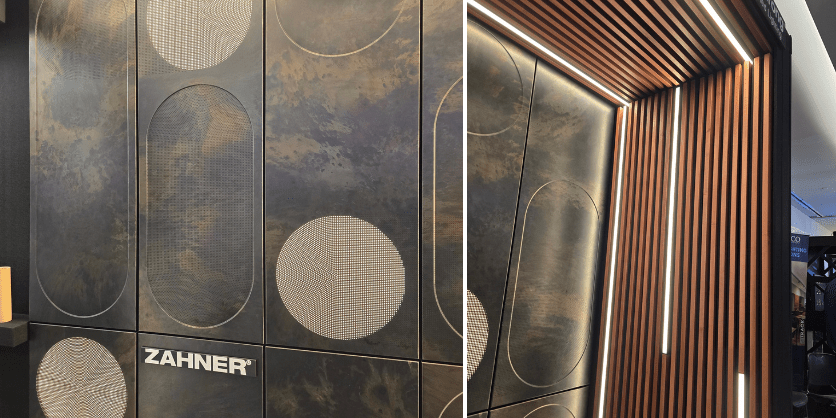
The Moda Aeris line, from Zahner, uses micro-perforations with an integrated acoustic backer to absorb ambient noise, dampen reverberation, and reduce echo, without changing the panels’ size, shape, or luminosity.
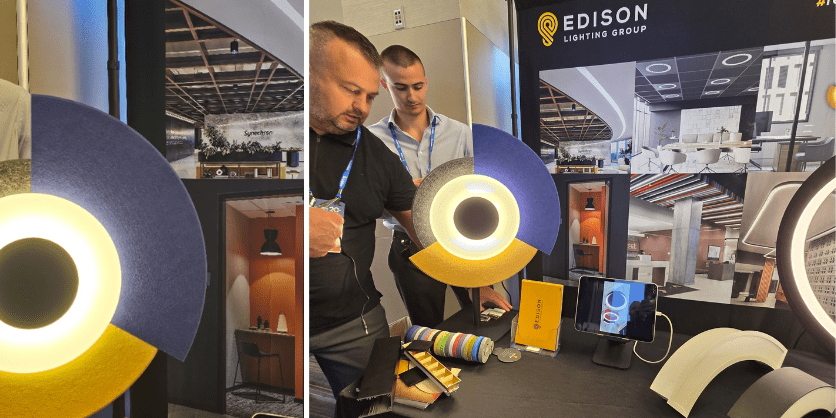
Edison Lighting Group of Ontario, Canada, displayed its Sonic COR+ Acoustic Round Luminaire, which features a sound-absorbing eco felt acoustic panel that is made from recyclable plastic material available in different thicknesses. The round diffuser is made from frosted PMMA polycarbonate. Sonic COR+ is suitable for surface and wall-mounted installation and the 90+ CRI COB LED spot is rated for 60,000 hours. Custom modifications can be made.
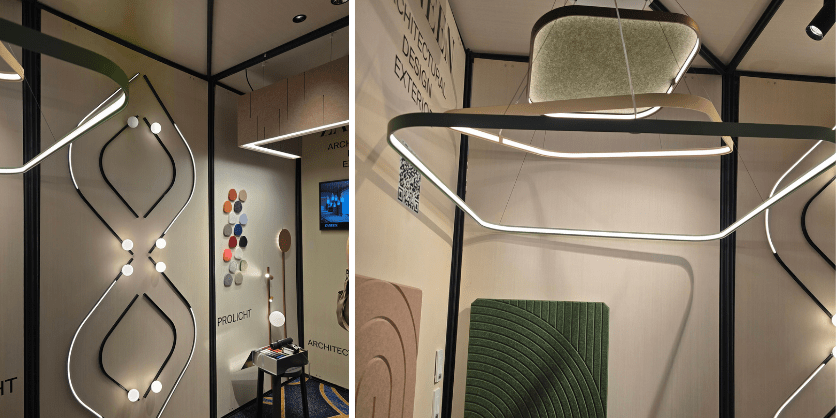
Manufactured in Austria by Prolicht, the Quantum Silhouette Acoustic panel fixture with an opal diffuser is available through Toronto-based Zaneen. The thin square frame with rounded edges is made of aluminum and can be ordered in a variety of powder-coated finishes. The acoustic panel helps reduce ambient noise in lounges, academic settings, offices and hospitality spaces.
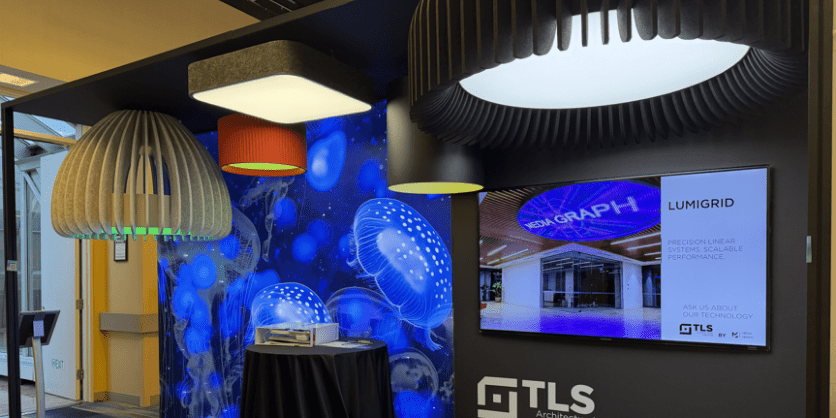
LumiCoustica is a collection of integrated acoustic lighting systems from TLS Architectural Lighting by Media Graph in Québec. These generously proportioned architectural fixtures combine LED illumination with sound absorption using premium PET. The company’s Pinna, Domus, and Carra Silenza models are especially made for high-volume spaces in hospitality, office, and healthcare and educational spaces and offer both vertical and horizontal variations.
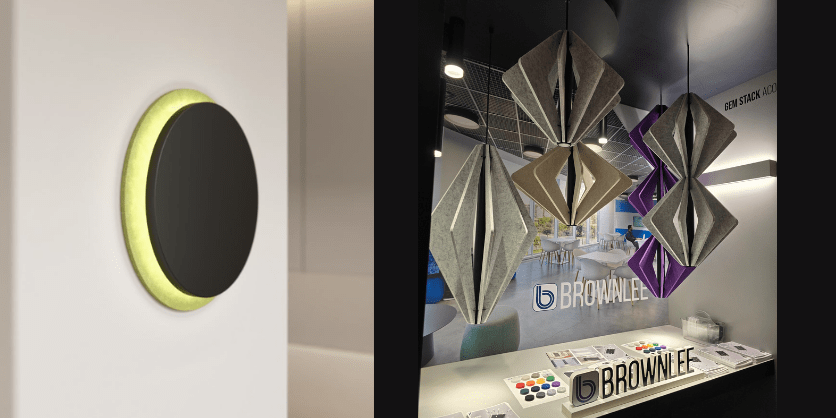
Domestic manufacturer Brownlee Lighting brought out new fixtures to its acoustic line, including the Gem Stack decorative chandeliers featuring PET felt and Hover Acoustic wall-mounted fixtures. Hover’s floating spun aluminum trim is available in nine colorful, powder-coated finishes and with a choice of nine acoustic PET felt colors. Hover comes in two sizes and has a projection of only two inches, making it ADA-compliant.
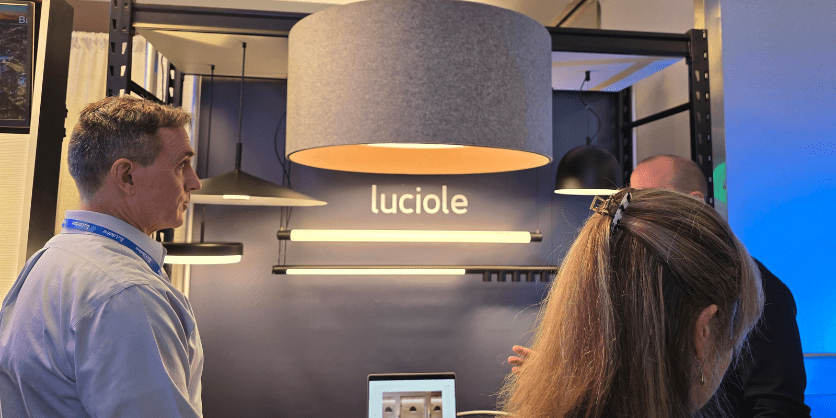
Montréal-based Luciole Lighting displayed its acoustic designs, including the Tambour series, available as a wall- or ceiling-mount and comprised of sound absorbing materials such as 100% wool felt and cork. Many felt colors are available and can be combined on the same assembly for the exterior and interior of the shade. The LED light source is concealed behind a recessed opalescent acrylic diffuser for optimal visual comfort.
Itsy Bitsy Teenie Weenie
Thanks to LEDs’ small form factor, product designers and engineers are able to shrink the envelope needed to encase legacy light sources and create low-profile versions of architectural recessed linear and spot fixtures as well as scaled-down landscape and accent lights.
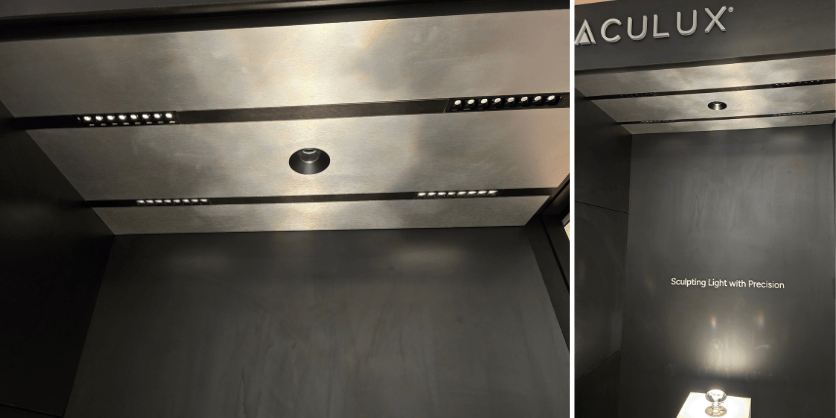
At Acuity Brands’ Aculux booth, the Lini series of miniature linear downlights – featuring 1″-square apertures – got a lot of attention. It was shown incorporated into simulated wood and metal ceilings and, as one attendee noted, “Wow, that is VERY discrete.” There are five lengths available, and each downlight delivers 370 to 2230 lumens. Five finishes and flanged and flangeless trim styles are offered with optics designed to keep light off the baffle, allowing the light source to disappear.
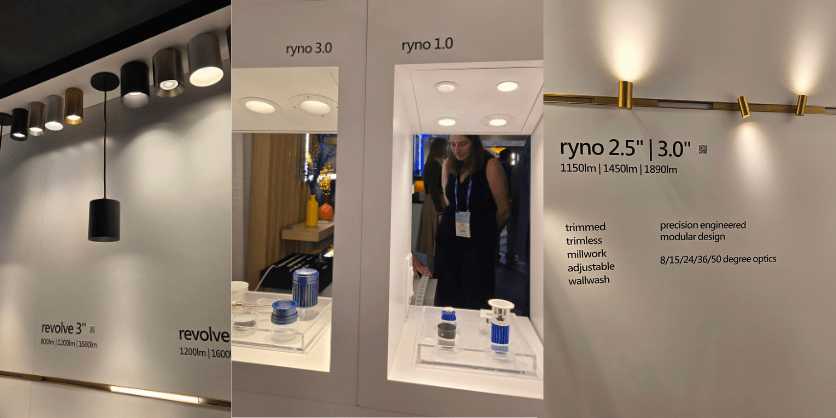
Brooklyn-based Rayhil Lighting showcased additions to its Ryno Recessed downlight series, including a 1-inch aperture module that provides 80 delivered lumens per watt in a low-profile form. It is offered in round or square trims in white and black, as well as trimless, millwork and adjustable options. The company also highlighted its new brass finish.
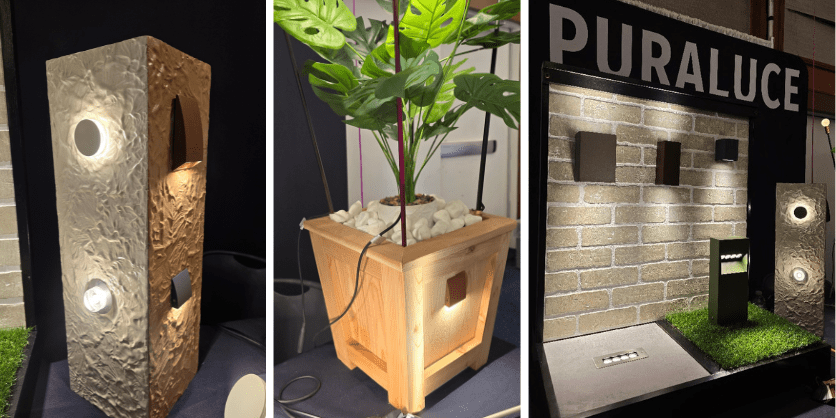
Headquartered in Italy with a North American office in Vancouver, B.C., Puraluce is known for its multitude of metal finishes as well as its Italian-made fixtures and lamps, according to a representative. One of the most popular items in the line is the ultra-slim Next step light.
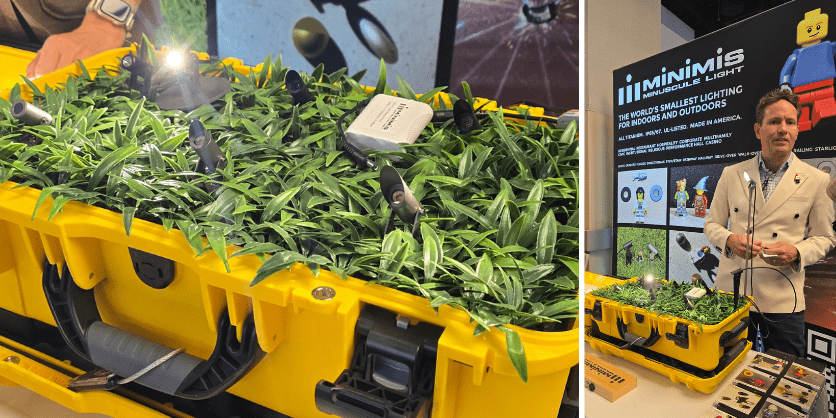
Billed as “the world’s smallest landscape light with a fixture diameter smaller than a dime and an aperture the diameter of a pencil eraser,” the titanium Tack series by Florida-based Minimis features custom-milled optics from Milan and Scandinavia plus a sapphire crystal lens. Tack is suitable for IP65/IP67 installation in any application — including marine, arctic and desert conditions. It can be installed into grass, earth, mulch and gravel to light walls, pathways, bushes, small trees, raised planters, and stone stairs. Removable stakes enable Tack to be fastened to pergolas, trellises, arbors, rafters, and tree branches.
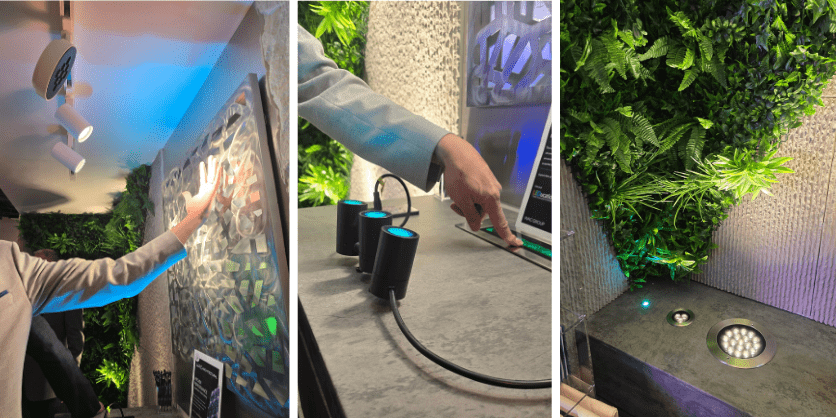
LEDucation marked New York-based WAC Architectural Lighting’s debut as a new brand of WAC Group. Among the new products was Trinity Chain, a professional-grade LED flexible linear light for high-end outdoor lighting applications. It has a compact form, an all-glass surface design, and offers multi-directional adult angles.
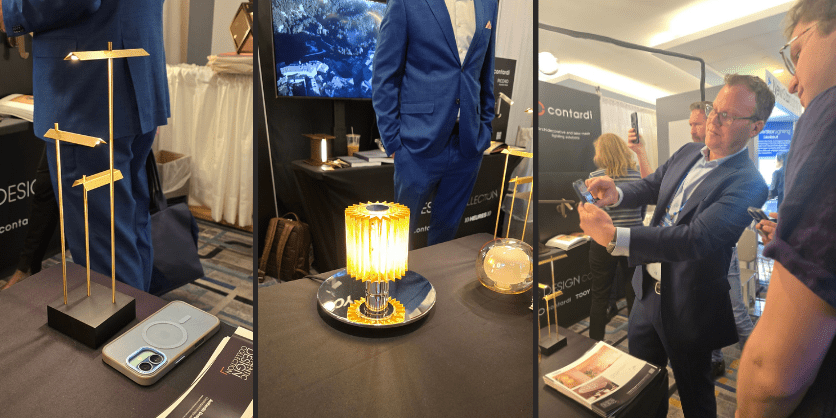
At New Jersey-based Authentic Design Collection displayed a new tabletop accent lamp featuring a cluster of modern-style lights suitable for restaurants and other hospitality applications.
Additive Manufacturing
Known for its acoustic lighting line, LightArt has expanded its product categories to include 3D-printed lighting in 2019. Not available on the market yet, LightArt previewed a new collection of 3D-printed pendants launching in October 2026. The collection features refined radial forms available in six shapes and 15 stock colors.
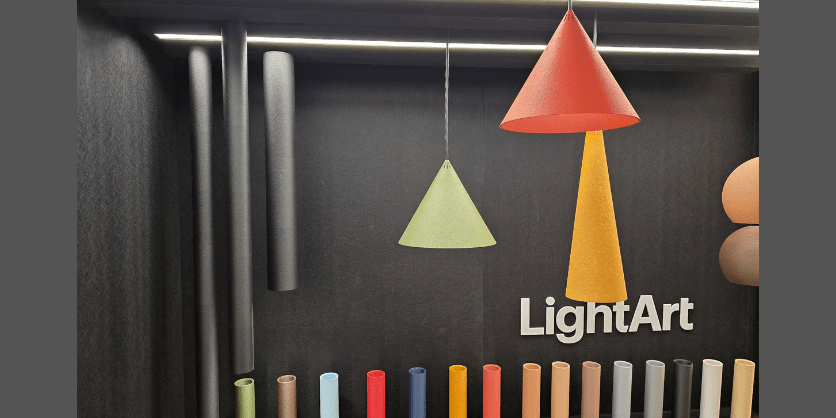
Additionally, LightArt showcased Cloudform Beams, launched in March 2026; built for acoustical and lighting performance with 1,000 lumens per foot. Unlike past acoustic products made with felt, this line boasts a lightweight fiberglass shade that provides powerful acoustics and can be specified in 31 stock colors along with custom offerings from the Sherwin-Williams color palette. All LightArt products include PVC-free power cords and TGIC-free powder-coated components.
Genlyte’s Lightolier brand was one of the first in the industry to embrace 3D-printing technology in lighting and has showcased its 3D printing capability for several years at LEDucation.
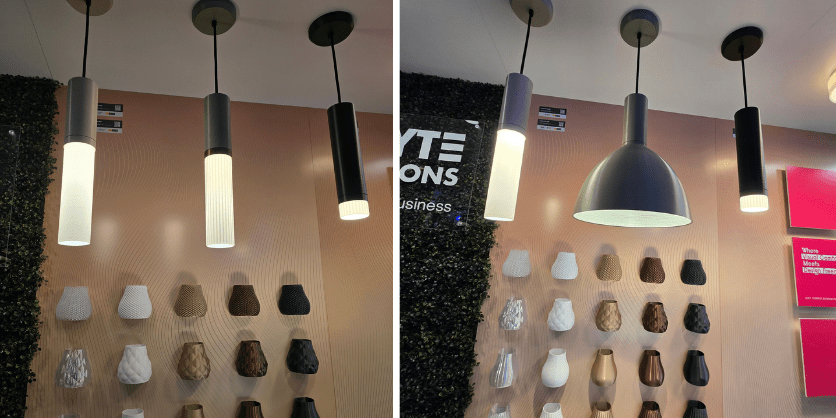
The company’s booth detailed how the ICY Series, powered by Genlyte’s additive manufacturing technology (myCreation), has expanded in textures and shapes. The newest cylinder pendants, for example, are designed to resemble reeded glass. For the large dome pendants, a company representative explained that the interior layer of the dome version can be different from the exterior.
The ICY series is printed and assembled in Pennsylvania and is BAA-compliant. The approximately lead time for standard finishes and components is three weeks.
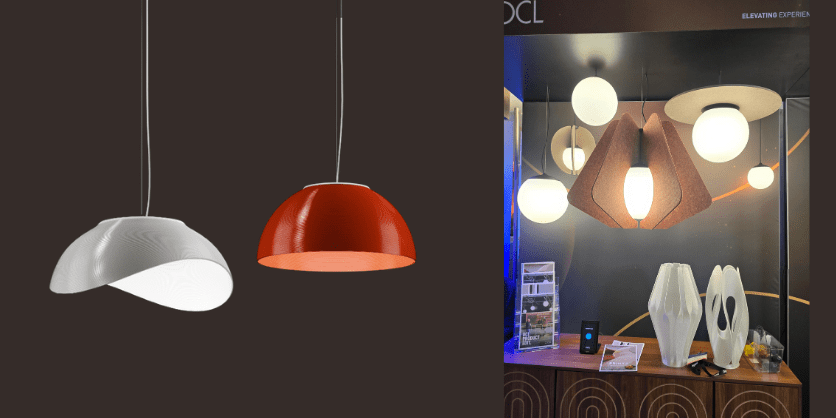
In addition to acoustic lighting designs, Legrand’s OCL brand added to its 3D-printed Printz line. These architectural-scale, large-format, additive manufactured pendants combine the Centro™ light engine with 3D-printed shades in three shapes made from a minimum 85% post-industrial recycled PETG. The Printz line is available in three LED performance packages with outputs up to 3,785 delivered lumens (depending on size and finish). The line meets BAA requirements.
Other outstanding product intros
New Jersey-based Authentic Design Collection showed the popular kinetic Focus chandelier from DCWéditions – designed by Japanese architect Yuji Okitsu – which attracted a lot of attention from attendees as it gently swayed. Inspired by soap bubbles, the dimmable fixture is available in many configurations and in a black or white frame. On the table were several In the Sun cordless accent lamps (the style is also offered as a pendant), designed by Dominique Perrault and Gaëlle Lauriot-Prévost and inspired by the Sun King (Louis XIV) at Versailles.
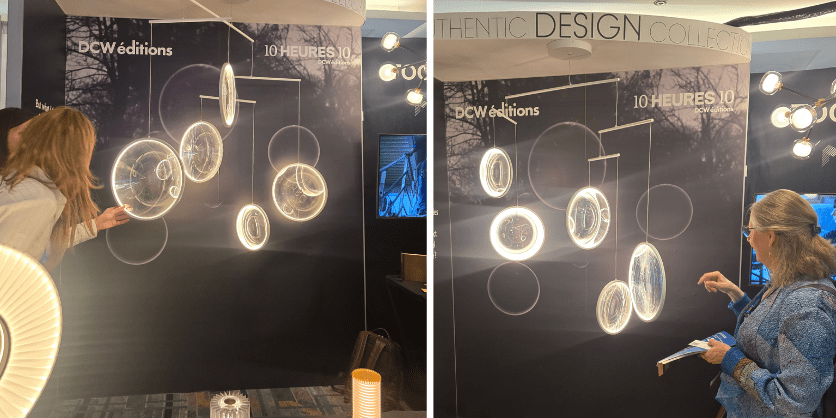
Founded by lighting veteran Blair Hutkin, Authentic Design Collection offers a curated selection of designs from renowned French and Italian manufacturers with the goal of providing designers, architects, and retailers with distinctive, premium products.
Among the products getting attention at South Carolina-based Access Lighting was the new line of Marine-Grade fixtures — one of which (Edge) is also Dark Sky-compliant and has an emergency battery back-up system.
Also shown at LEDucation were new outdoor fixtures, such as Ari Clear with a ribbed diffuser and the Ari Grid with a perforated pattern.
(The red light cage accent lamp was a custom order promotional item for Fox Studios, made to resemble the “on air” light used by TV stations.)
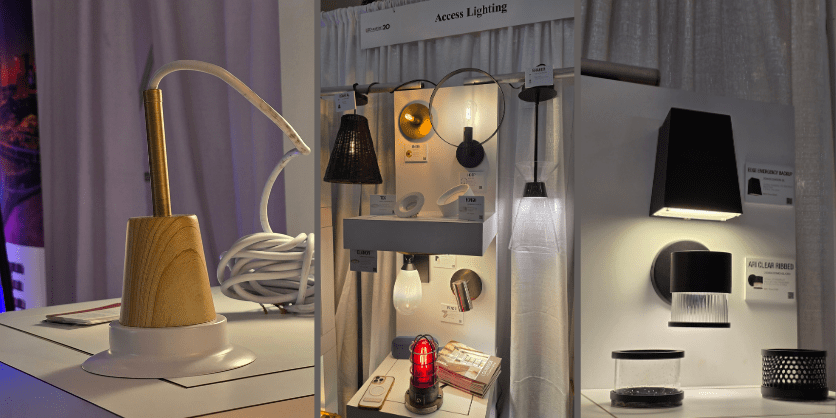
Company president Janine Segal noted that the painted faux wood finish – available in several wood tones – has been especially popular. “It’s an affordable option to wood,” Segal said.
Headquartered in Germany, Moss Objects featured a few of its most popular architectural lighting designs at LEDucation.
The Dune series has a wide, flat geometry and a sculptural presence that can be expanded in two dimensions, making it suitable for spaces with lower ceiling heights as well as vertically oriented to fill tall spaces.
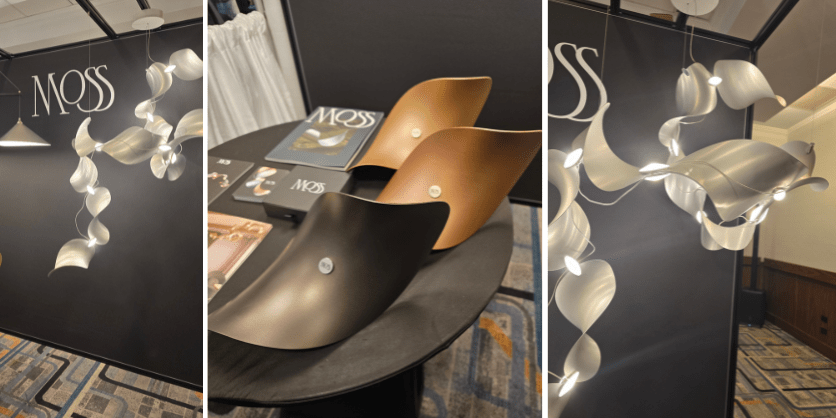
“The aluminum can be shaped in many ways,” noted company founder and designer director Daniel Becker. All of the pieces are handmade to order in Germany and custom configurations are welcome. Materials used include aluminum, brass, steel and oak.
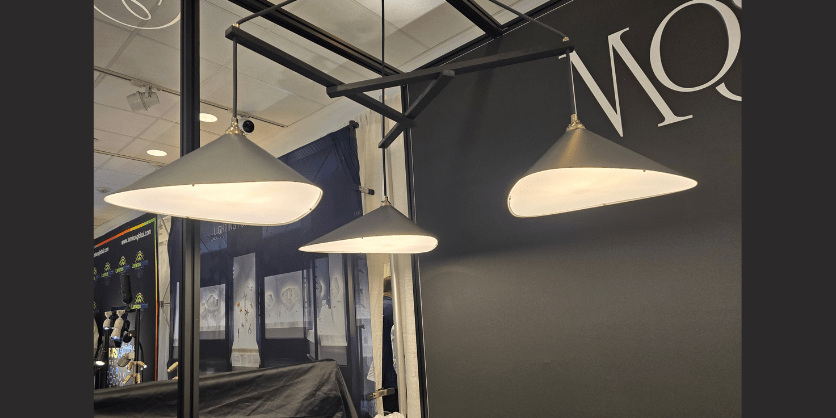
Also on display was the Emily chandelier series comprised of handmade sheet steel lampshades in an organic, elongated shape. This series is also able to be constructed vertically or horizontally to suit a wide range of spaces. Not shown at LEDucation but available as part of the series is Emily Oxid, which is formed from aged steel plates whose surfaces have developed unique patterns through years of oxidation.
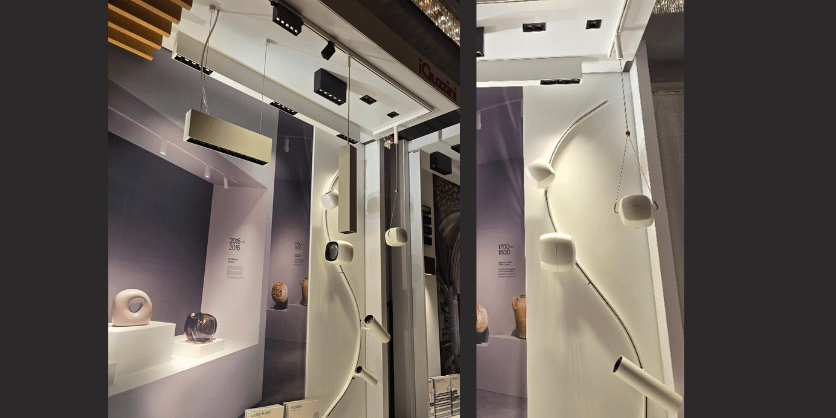
Headquartered in Italy, iGuzzini displayed its Newfo “squircle” design elements on track lighting for an unexpected versatile and contemporary form. According to the company, Newfo is as a tribute to Ufo, the first projector to bring the precision of theatre lighting into architecture in 1977.
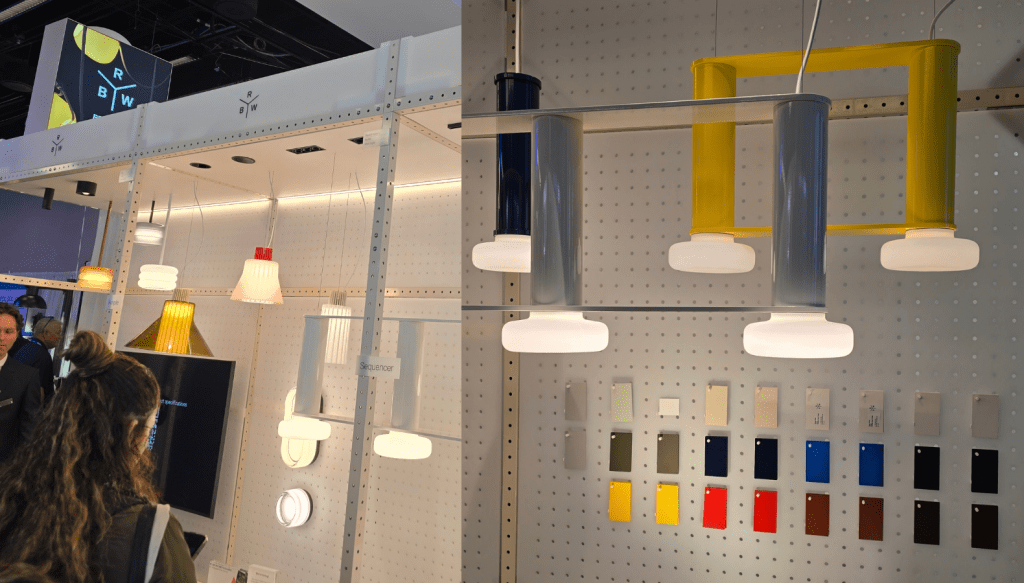
Color was the focus at RBW, which debuted its Custom Colors selection along with 40+ colors across its product line. The domestic manufacturer built its own powder-coating production space from the ground up at its headquarters in Kingston, New York. According to the company, its finishes are engineered for longevity, maintaining color and clarity through years of use, and are tested for UV stability, durability, and performance.
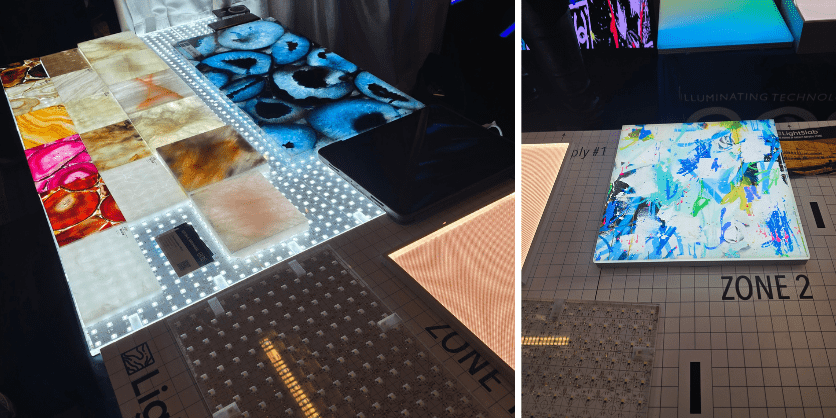
New York City-based EOS Light featured its patent-pending integrated backlight panel system – LightSlab™ – which is designed for natural stone applications. Each panel measures 9.4′ × 4.7′ and can be trimmed on-site to fit any architectural opening. The system is comprised of an acrylic base, an LED sheet, and LED LightPaper. It is field-cuttable and ships flat, ready to install.
EOS Light counts commercial, retail, municipality, hospitality, luxury residences, “international brands and major celebrities” worldwide as clients.
EOS displayed a sample from its LuxArt line, which embeds LED lighting into aluminum-framed artwork. The designs can be adapted for its Cloud/Outdoor Cloud luminaire series, as a showroom panel, or as a LightPanel with printed diffusers.
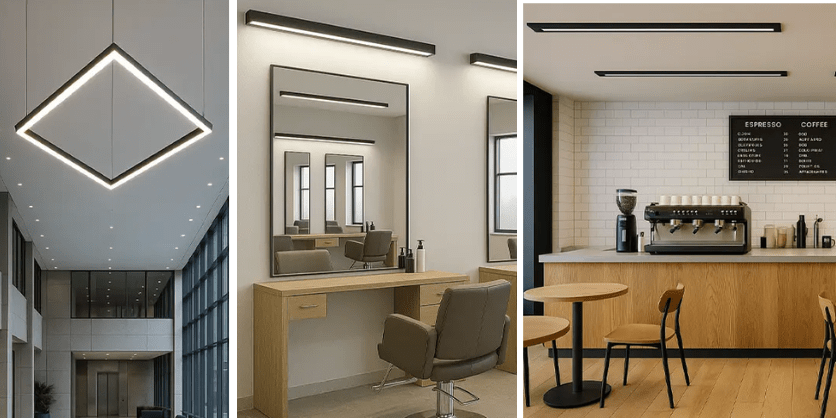
New York-based SATCO showcased its new Momentum linear architectural system for commercial, hospitality, institutional, retail, and office applications. It offers field-selectable light distribution (3 wattages, 3 CCTs), a range of mounting options (surface/recessed/suspension and wall-mount), and optional PIR sensors to enhance efficiency through motion sensors. It can be ordered in a black or white finish.
LEDucation attendees liked the fact that it could be configured into an assortment of shapes and has up and down light controls.
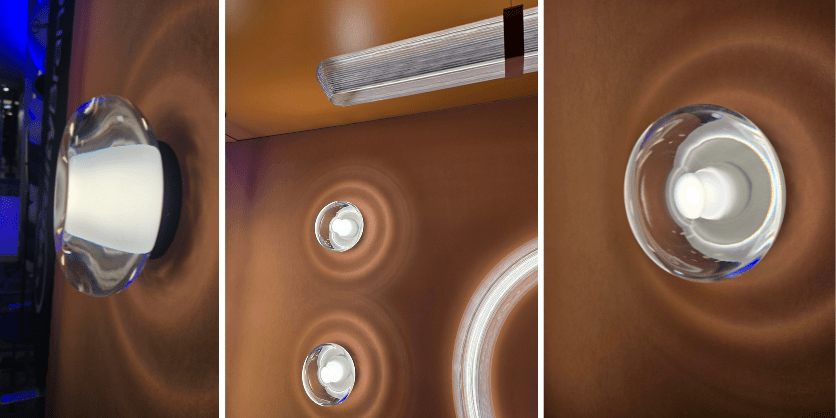
Montréal-based Eureka Lighting, part of Acuity Brands, featured its Torno series, which is versatile enough to be installed as a pendant (and can be stacked in two or three layers) or surface-mounted on the wall or ceiling. What makes the aesthetic especially interesting is its integrated conical reflector that creates a nice spread of low-glare light through the frosted diffuser. It is offered in 2700K, 3000K, 3500K, and 4000K with 90+ CRI.
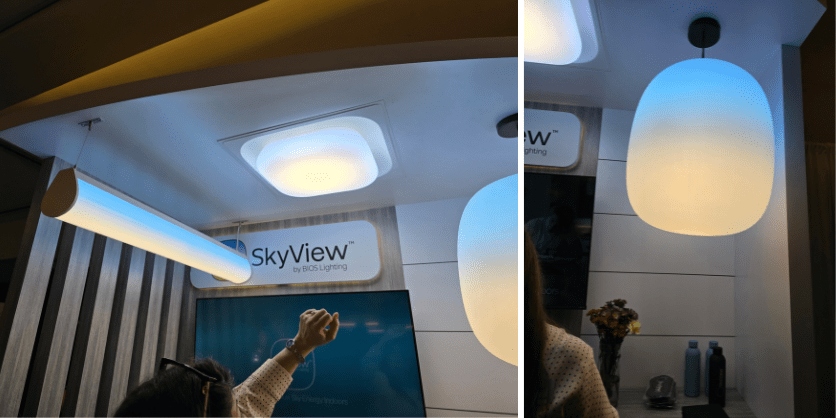
The latest development from California-based BIOS is its Skyview™ line featuring its patented Blue Sky Gradient Technology. The premise for its development lies in this question: “Do you ever notice how much better you feel on a blue sky, sunny day?” The company’s literature explained, “Humans are naturally drawn to blue sky light. Researchers have discovered a receptor in our eye that senses the blue sky and speaks directly to our brain, regulating our mood, focus and alertness.”
According to the company, SkyView™ works on a “biological level,” using a patented light engine to replicate the visual and non-visual information people receive from natural light. “It changes wavelength and intensity picked up by the special photopigment, melanopsin, in our eyes.” The Skyview product line is available as ceiling-mounting fixtures as well as portable lamp versions.
New York-based WAC Architectural’s Falcon High Power track fixtures provide precise beam control and glare management that is ideal for museums and galleries. A variety of beam angles are available: Very Narrow 11°; Spot 15°; Narrow Flood 24°; Medium Flood 36°; Flood 40°; Wall Wash/Asymmetric; Grazer 18° x 52°; and Elongating 13° x 45° as well as four color temperatures.
WAC Architectural also unveiled its commercial-scale outdoor landscape and bullet fixtures. The Fuego Compact series of in-ground fixtures range in diameters from 1-inch to 10 inches.
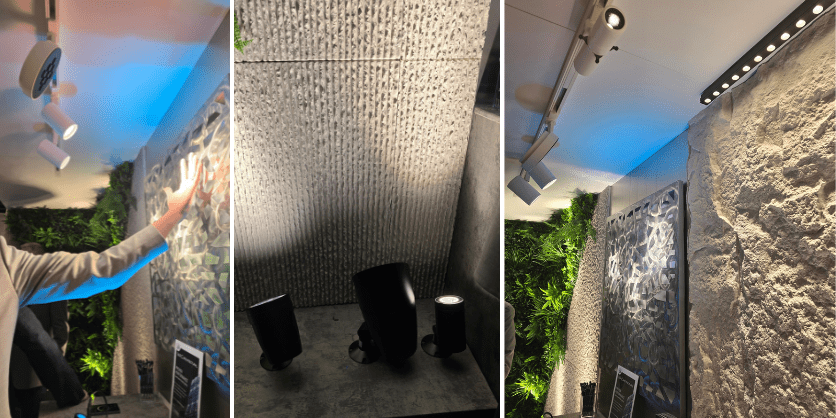
The company’s PANTHER series is ideal for architectural façade lighting and landscape spotlighting. Available in a variety of sizes, the fixtures have a low-profile design, high optical performance, and support vertical or horizontal mounting with precise adjustments in the direction of rotation.
It was Avenue Lighting’s second time showing at LEDucation and the California-based company unveiled several new decorative designs such as the sculptural Palmea Collection featuring scalloped oval glass as multi-light suspended fixtures.
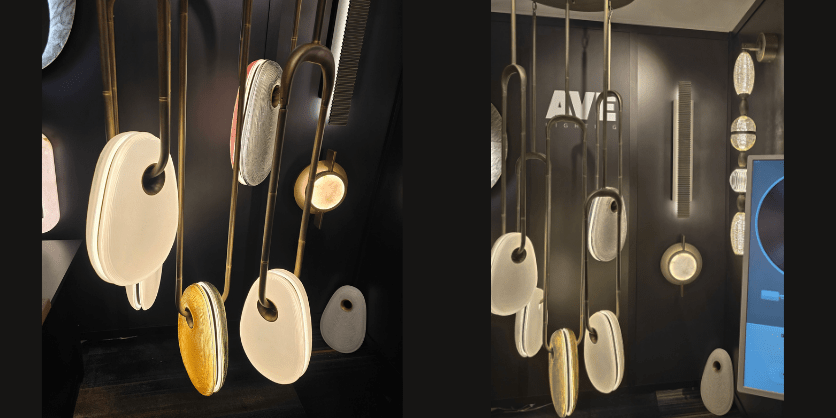
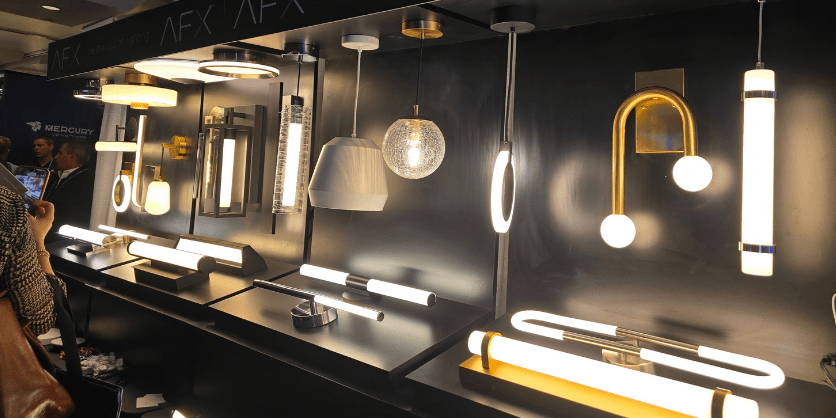
Chicago-based AFX brought out an assortment of its vast product line to LEDucation. Noting the wide cross-section of interest from attendees – from architects specializing in higher-end office spaces to specifiers for multi-family projects – a spokesperson noted the company opted to show a sample of what it has to offer. AFX also recently entered the ceiling fan category.
Look for more LEDucation show coverage next week.
Related articles