How Strong Is the Multifamily Sector? Depends on Who You Ask
The average American consumer is having trouble affording a single-family home, and the condo market is soaring out of reach as well. The multifamily and the BTR sectors may be a solution, but even they are losing momentum.
On the micro level, you’ve probably seen a lot of construction activity in the multifamily sector in your local community due to a constrained housing supply and continued demand. That lack of housing, coupled with a higher interest rate that is keeping many homeowners in place, has led to uptick in the rental market — especially in metro areas.
The macro view, is a bit different, where gains in the multifamily market are a mixed bag. According to statistics released by Yardi Matrix last month, “The market remains in a tight spot… Ongoing supply pressures are likely to limit rent growth, while the high cost of homeownership continues to keep many potential buyers in the rental market.”
For the past several years since the pandemic and the rise of remote offices, certain areas of the country – particularly the outlying areas of metros – had trouble keeping up with the housing demand as people moved further out from average commuting distances in order to buy larger homes for their budget.
Then came the business incentives, with many states offering relocation tax credits or income tax exemptions. Indiana, Ohio, West Virginia, Missouri, Mississippi, Arkansas, and Nebraska are just some of the states that rolled out programs to entice corporations to relocate. Those incentives led to increased demand for multifamily housing as large companies (think Tesla, Oracle, Chevron, Caterpillar, and Fisher Investments) moved their headquarters and needed to accommodate staff.
As those projects reached completion – especially in the Sun Belt, which attracted the lion’s share of new residents – there has been a gradual drop in future plans. This, in turn, has led to some sluggishness in construction.
Furthermore, Yardi Matrix’s experts cite reduced immigration, slower job growth, and the conflict with Iran as reasons for the economic slowdown in the multifamily sector. Yardi Matrix’s report added, “Prior to the escalation [in Iran], markets anticipated a steady path of Federal Reserve rate cuts throughout the year. However, rising geopolitical tensions – and their impact on global energy markets – have shifted expectations toward a prolonged ‘higher-for-longer’ rate environment as the Fed remains focused on containing inflation…As a result, borrowing costs are rising, directly impacting commercial real estate through tighter financing conditions and continued pressure on asset valuations. If the conflict persists, elevated energy prices could place sustained pressure on household formation.”
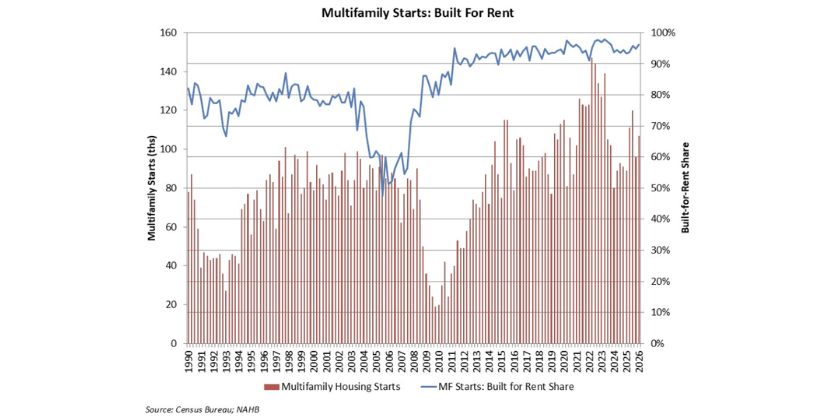
This week, the National Association of Home Builders (NAHB) released its First Quarter 2026 Multifamily Construction Data. Senior Vice President & Chief Economist Robert Dietz reported that the number of multifamily, for-rent housing starts increased year-over-year during the first quarter of 2026. For Q1, construction started on 107,000 multifamily residences, of which 103,000 were built-for-rent (BFR). NAHB data shows that the BFR total was 21% higher than in the first quarter of 2025.
In fact, the BFR sector has been gaining popularity over the past two or three years — although admittedly, BFR is not technically “multifamily” even though it can get lumped into those statistics depending on the source.
How does BFR differ from the typical apartment or condo complex? While both are constructed to be leased, they are not interchangeable terms. “Built-to-rent” typically refers to separate homes that are grouped together into a community that shares amenities such as a clubhouse, pool, and fitness center. The BFR housing cluster resembles more of a neighborhood than the multi-storied apartment buildings that share common entrances, hallways, etc.
What has made the BFR market attractive from an investor standpoint is – as an article in U.S. News & World Report noted – “because homes in BFR communities are put together all at once, they can, in theory, go up a lot faster than single-family subdivisions, where builders constantly check in with home buyers and defer to their questions and concerns as the construction goes along.”
However, analysis released this week by NAHB, based on data from the Census Bureau’s Quarterly Starts and Completions by Purpose and Design, revealed that there were approximately 14,000 single-family built-for-rent (SFBFR) starts during the first quarter of 2026. “This is down measurably from the first quarter of 2025 (19,000).”
“Over the last four quarters, 62,000 such homes began construction, which is a 26% decrease compared to the 84,000 estimated BTR starts for the prior four quarter period,” NAHB’s Dietz pointed out.
On the condo side of the market, NAHB reported that there were 4,000 multifamily condo unit construction starts in Q1, which is down significantly from one year ago (7,000). “Ongoing housing affordability challenges” was cited as the cause.
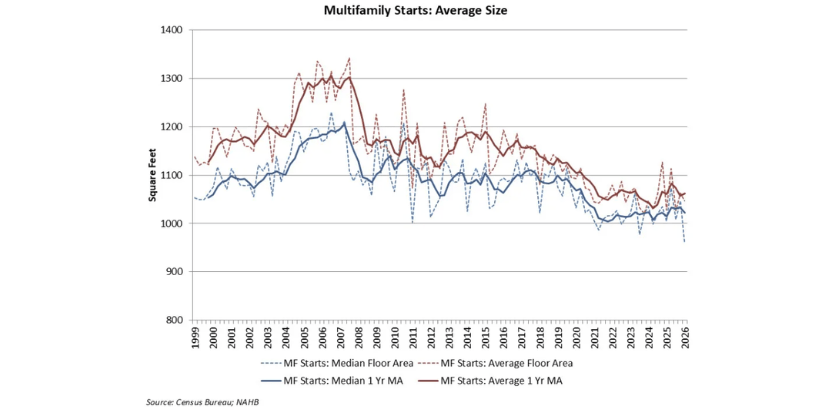
There is another change happening in multifamily and the BTR market that is related to the affordability crisis — reduced square footage.NAHB’s Q1 Multifamily Construction Data indicates that more rental construction has “apartment size below levels seen during the pre-Great Recession period. According to the association’s Q1 2026 data, “the average square footage of multifamily construction starts declined to 1,047 square feet. The median, or typical unit, posted a large decline to 960 square feet, the lowest on record. These measures are consistent with the elevated share of multifamily built-for-rent construction.”
With less square footage – which also translates to a reduction in ceiling heights when it comes to two-story foyers – lighting manufacturers who have been used to upsizing their fixtures to suit the higher-end McMansion market as of late are now finding themselves needing to produce fixtures that are smaller in scale, but still offer high visual impact.
None of the sources cited in this article believe that the trend for reduced square footage in multifamily, BTR, and single-family homes will be reversed any time soon. Lighting manufacturers and distributors should prepare for sustained demand in modestly sized fixtures suitable for these markets going forward through at least 2027.
Related articles