AI is the New Circadian Lighting
Over the years, there has been certain terminology that the industry hangs onto — damage can be done, however, when a catchy buzzword is overused and no longer correctly describes a technology or product at hand.
By C. “Webster” Marsh
The lighting industry loves a big bright idea and every few years, a phrase comes along that seems to carry the future on its back. It shows up in conference sessions, product literature, sales presentations, white papers, and booth graphics. It is flexible enough to mean many things, powerful enough to attract attention, and vague enough to make everyone a little nervous.
For a while, that phrase was “Circadian Lighting.”
To be clear, the premise was not nonsense. Light does affect people. It affects visual comfort, alertness, sleep, mood, and biological rhythms. The research around light and human health is real, important, and still evolving. The industry was right to pay attention.
But then the market got hold of it.
Suddenly, “circadian” was everywhere. So was “human-centric.” So was “wellness.” A complicated scientific subject became a sales language. In some cases, the claims were careful and defensible. In others, they got ambitious. Lighting was going to improve productivity, support healing, enhance learning, boost wellbeing, and maybe fix the printer while it was at it.
The problem was not that circadian lighting had no value. The problem was that the advertising often moved faster than the evidence. The science had nuance. The marketing preferred certainty.
Now we may be watching the same movie again, this time with “artificial intelligence” (AI) in the starring role.
AI is entering lighting and building controls with a great deal of promise. Some of that promise is real. Used well, AI could help solve problems this industry has struggled with for decades. It could make startup less painful. It could help identify failed sensors, poorly performing sequences, or systems that drift out of tune after occupancy. It could help facility teams understand what is happening in a building without forcing them to become controls engineers. It could make energy-code compliance easier to document and maintain. That would be meaningful. In fact, that would be more than meaningful. It could be transformative.
Because let’s be honest: lighting controls do not need more complexity. They already have plenty. What they need is better usability, better persistence, better documentation, and better trust. If AI can help deliver those things, it deserves a serious place in the conversation.
But there is another possibility.
AI could also become the industry’s newest magic adjective.
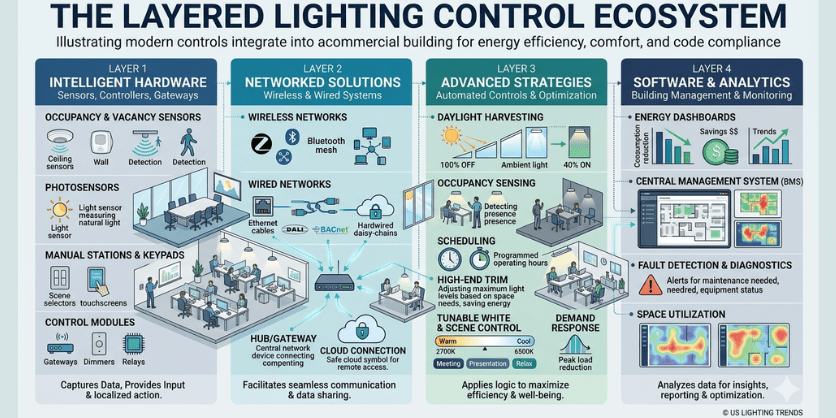
A product that once had automation may now have AI. A dashboard may become an AI dashboard. Rule-based analytics may be described as “intelligence.” A control sequence may be called “adaptive” because the word sounds better than programmed. In that version of the future, AI does not transform the building. It transforms the brochure. That is where comparisons to circadian lighting become useful. Not perfect, but useful.
Both ideas start with something real. Circadian lighting starts with the fact that light affects human biology. AI starts with the fact that data-rich systems can make better decisions — or at least help people make better ones. Neither idea should be dismissed. But both ideas can be damaged by overuse.
When every claim becomes expansive, every claim becomes suspect. Engineers, specifiers, contractors, owners, and facility managers have heard big promises before. They have seen control systems installed with great expectations, then partially disabled, overridden, misunderstood, or ignored once the building is occupied.
So, the question is not whether AI sounds impressive. Of course it does. The question is whether it helps.
Does it reduce labor? Does it make a contractor’s job easier? Does it help a commissioning provider find problems faster? Does it catch operational issues before the owner complains? Does it help a facility manager understand the system on a Tuesday afternoon six months after turnover? Does it save energy in the real building, not just in the sales presentation?
Those are the questions that matter.
The lighting industry does not need AI to make controls more mysterious. It needs AI, if anything, to make controls less mysterious. Less intimidating. Less fragile. Less dependent on the one person who understands how the system was originally set up and has since moved to another company.
That may be the real lesson from circadian lighting. Big ideas are not the enemy. Ambition is not the problem. The problem is when the story gets too far ahead of the evidence, and the customer is left to sort out the difference between a serious capability and a slogan.
AI may become one of the most important developments in lighting controls. It may help the industry solve the unglamorous problems that have limited adoption for years. It may make systems easier to install, easier to operate, and easier to trust. Or it may become another heavily advertised concept that leaves people wondering what was actually delivered.
The difference will not be determined by how often we say “AI.” It will be determined by whether we can clearly explain what the technology does, what problem it solves, and what evidence supports the claim.
Before AI becomes the next circadian lighting, the industry should ask a simple question: Are we selling intelligence or just the appearance of it?
______________________________________________________________________________________
About the author
C. “Webster” Marsh is a Lighting Controls Designer at Sladen Feinstein Integrated Lighting and as Education Manager for the Lighting Controls Academy.
A Certified Lighting Controls Practitioner (CLCP), Webster is also Director of Education and Programming for ArchLIGHT Summit, creator of Tonight in Controls, and he co-hosts the Lighting Controls Podcast, helping professionals stay connected with the latest in lighting controls.
Related articles by C. Webster Marsh