
Purple Rain & the Streetlight Industry’s Next Big Opportunity
Prince would have appreciated the irony.
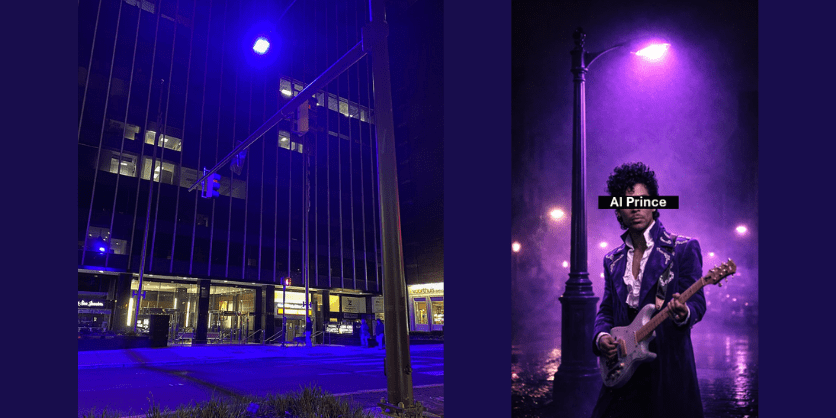
Starting in early 2021, streetlights across America started turning purple. Not a few of them, not in one city, but thousands of fixtures in more than 30 states, glowing violet like something out of a music video. The internet went wild with explanations. In Minnesota, people figured it was a tribute to the Purple One. Elsewhere the theories got creative: the lights were protecting birds, or bats, or making vaccinated people glow in the dark. In Vancouver, someone blamed vampires.
The real cause? A manufacturing defect. The fixtures in question had a problem with the phosphor layer that converts blue LED light to white. When that layer fails, the blue diode underneath shines through purple. An embarrassing quality control problem that cost $52 million in warranty claims by 2023.
But here’s what should interest anyone in the lighting business: people assumed their city had done something intentional, something thoughtful about public space. For many non-street lighting folks, the purple lights were a feature — not a bug.
Think about what that means. Citizens invented reasons to celebrate streetlights that did something different. Prince tributes. Wildlife protection. Environmental stewardship. They wanted their public lighting to mean something. These non-street lighting folks are ahead of the industry.
The technology to deliver on those expectations exists right now. There are streetlights on the market today which dim, change color, and change distribution. The vast majority rely a physical switch used at installation, but why not a virtual switch triggered by lighting controls in near real time? We could deliver amber light during bird migration, reduced output near sensitive habitats, local NFL team colors in vibrant downtowns, or “purple rain” for a Prince anniversary if anyone wanted it. When customers ask if they can do something different, you should be able to say, “yes.”
So why don’t we?
One might argue that cities won’t pay for that kind of thing. That taxpayers expect their streetlights to be boring and functional.
To which we’d point out: Christmas.
Every December, municipalities across the country transform their public rights-of-way. Decorative lighting on poles and trees. Changed schedules for holiday displays. Entire streetscapes lit up for celebration. Nobody demands ROI calculations. Nobody questions whether it’s “appropriate” for public infrastructure.
If cities can do it for Christmas, why only Christmas? Why not for bird migration? Cultural celebrations? Neighborhood identity? Public safety events?
The answer has less to do with what customers will pay for and more to do with what the industry has been selling them.
The LED conversion of the past 15 years ran on a powerful economic engine: utility rebates buying down upfront costs, ESCO financing eliminating capital outlays, and massive energy savings providing the payback. The pitch was simple – same light, lower bills – and it worked brilliantly.
That engine is now running out of fuel.
Early LED deployments are approaching end of life. The luminaires installed in 2012 and 2015? They’re coming due. Municipalities now face a new problem: replacing LEDs with LEDs. And the math doesn’t work.
There’s no massive energy delta to finance against when you’re swapping one LED for another. Rebate programs were designed for HPS-to-LED conversion, not LED-to-LED replacement. The ESCO model needs energy savings on a bill to generate payback. The playbook that built modern street lighting is obsolete. If you’re selling the same pitch –“same light, lower bills” – you’re selling into a headwind.
Which brings us to the opportunity.
The next sale has to be about capability, not just efficiency. About what the system can do for communities, not just how many watts it saves.
Photometrics AI, a software platform that works with existing networked lighting controls, offers a different value proposition. Instead of selling hardware replacements with diminishing returns, it delivers ongoing value through intelligent optimization: 40% energy savings (25% through precision design optimization, 15% through early-morning dimming when traffic drops), plus capabilities like real-time BirdCast integration for wildlife protection and priority-based scheduling for events and emergencies.
Capability is important, but the numbers make deals happen. We see approximately $61.81 per light per year in quantifiable value, split differently between utility- and municipal-owned and operated street lighting. That’s under 12-month ROI with no hardware needed and no field activity — just software only.
For contractors, distributors, and ESCOs looking at the LED-to-LED replacement cycle, this is the value-add that makes the next project pencil. You’re not just selling a fixture swap with marginal efficiency gains. You’re selling smarter infrastructure that delivers measurable results year after year.
The purple streetlights were an accident that revealed something important: people want their public lighting to be about something. The industry that has got comfortable selling watts and rebates now needs a new story.
The infrastructure is deployed. The technology is proven. The public appetite is real.
The only question is who is going to sell it to them.
Ari Isaak is the founder of Photometrics AI. Photometrics AI is a software platform that optimizes street lighting through networked controls. For more information, visit photometrics.ai or contact Ari Isaak at ari@photometrics.ai.
Related articles