
The Hottest Category in Sports Lighting
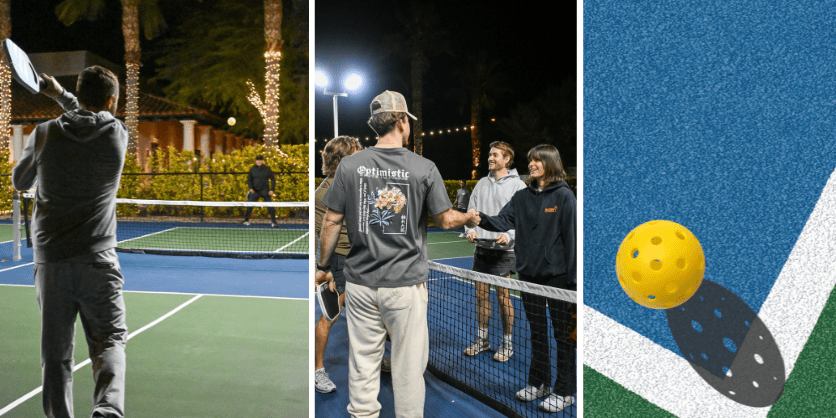
As pickleball courts continue to pop up in many city and suburban parks as well as planned communities – even replacing tennis courts in many instances – it provides a growing opportunity in sports lighting.
By Cory Peterson
Pickleball is now the fastest-growing sport in the U.S., and courts are multiplying fast. They are being added to recreation centers, outdoor communities, indoor facilities, and sports complexes at a pace the industry hasn’t seen before. One of the first decisions that new construction pickleball projects have to make is on their lighting investment.
Proper court lighting reduces glare that disrupts play and visibility during overhead shots. This ensures happy players and diminishes potential non-compliance with USA Pickleball standards. It also helps facilities to pass inspections and lowers the need for costly replacements, especially in a sports-related environment.
The two primary approaches to pickleball lighting, direct and indirect, solve different problems and suit different environments.
Direct light, also known as downlight, occurs when fixtures mounted above the playing surface direct their light output downward onto the pickleball court. This is a very popular approach for pickleball lighting. For outdoor courts, direct light means pole-mounted LED shoebox fixtures positioned around the court perimeter at a minimum height of 20 feet. For indoor courts, this means ceiling-mounted LED high bay lights in gymnasiums, recreation centers, and related areas, often installed at 20-28 feet above the playing surface. We have found that approximately 95% of pickleball lighting customers choose direct light, although indirect lighting remains a viable alternative and may be preferred in certain projects.
The advantages are considerable. Well-specified direct light delivers strong, even floor-level illumination, meets USA Pickleball’s minimum foot-candle (fc) requirements, and is energy efficient. For outdoor courts, cutoff optic direct fixtures are designed to minimize light trespassing into neighboring areas. Because of this, it remains the usual choice for courts in residential areas that require compliance with dark sky standards. (Dark sky standards are lighting practices that minimize light pollution and meet standards set by organizations, including the International Dark-Sky Association (IDA).)
There are limitations with this lighting type. Direct light alone can illuminate the floor well, but it may leave the upper space underlit. In pickleball, the primary playing area is above the net where the ball spends the most time, so this area should be well-lit, especially if the courts support higher competition levels. Direct lighting produces better dimension, allowing players to see the ball’s depth, shape, and spin more clearly, but it’s more likely to create glare. It is recommended to avoid placing direct lighting fixtures in areas where players frequently look during play.
Indirect Lighting & Pickleball
In the context of pickleball, indirect light, also referred to as uplight, is when light is directed upward toward the ceiling. Indirect fixtures work best with highly reflective, light-colored ceilings so the light bounces back down onto the court. Indirect light also further illuminates the space above the nets, improving ball visibility during overhead shots while reducing glare. A player who is tracking a rapid ball across the ceiling benefits from bright, uniform light. Pickleball lighting frequently uses indirect lighting systems in conjunction with direct lighting systems.
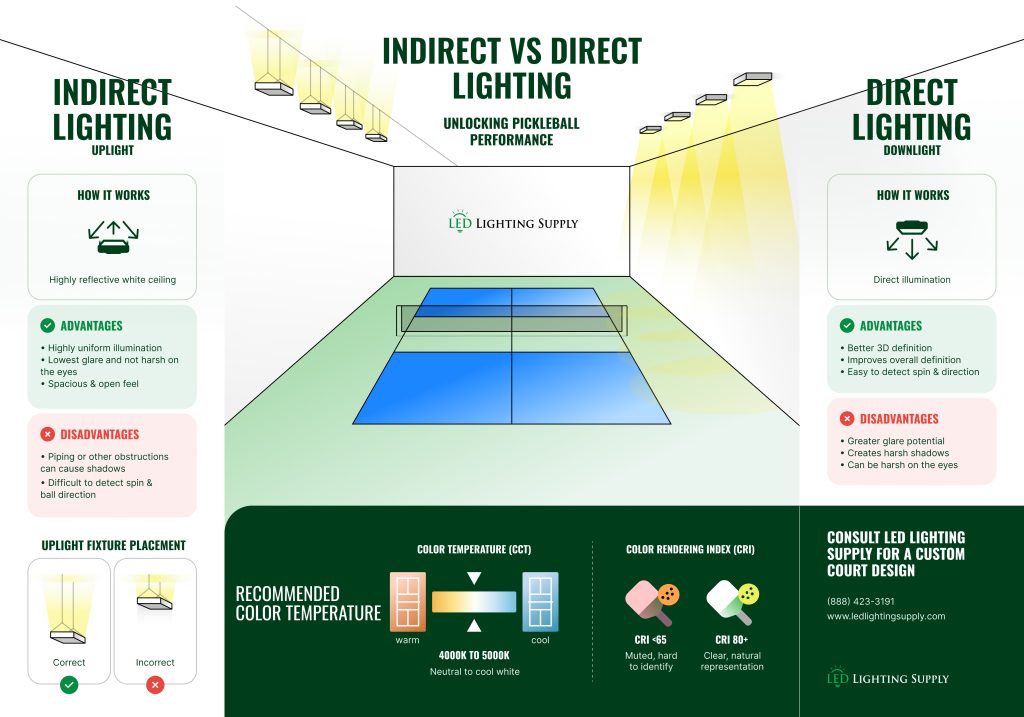
Neither system is universally superior to the other. Each approach requires considering these variables:
• Court type (indoor or outdoor): Outdoor courts are historically best served by direct lighting, such as pole-mounted, optic LED fixtures that minimize light trespass and sky glow. Indoor courts have more flexibility, but facility managers must closely evaluate ceiling height and reflectance.
• Ceiling height and surface: Indoor indirect lighting is best suited in environments with a ceiling height of 40-45 feet, mounted at 20-25 feet, allowing the light to reflect upwards for the remaining 15-20 feet of space from the mounting height to the ceiling height. At a minimum, there should be 10 feet above the fixture for light reflection. Indirect lighting also requires the ceiling to be made of a reflective surface material. White ceilings are most suitable. Direct lighting requires a ceiling height of 20-28 feet and no specific ceiling surface.
• Play level: Recreational courts can meet the 30 fc minimum with direct lighting alone. Competitive and club-level courts benefit from full illumination that direct/indirect systems provide for overhead play and reduce glare.
• Budget and maintenance: LED direct lighting systems can be more affordable and straightforward. Indirect lighting systems may involve higher costs and preparation considerations. However, both deliver a long service life compared to legacy metal halide systems, and some suppliers offer equivalent pricing for both lighting types.
Common mistakes
As pickleball continues to grow, lighting professionals and facility managers have identified several practices that simply do not work well for the sport. One example is the 20-foot minimum mounting height. This is no longer just a recommendation but the minimum height at which the lighting is best positioned to reduce glare on the court. Following this guideline is essential for both player safety and overall performance.
Outdoor courts that don’t follow dark sky standards can lead to complaints from neighboring properties and, in some cases, enforcement actions due to excessive light trespass. Appropriate fixture shields and angles should be considered before installation to prevent light trespass and pollution. A photometric lighting plan is used to show where the fixtures will be installed and how the light will disperse across the space. This makes it an essential step in the project planning process. Many lighting suppliers, like LED Lighting Supply, offer lighting plans at no additional cost as part of the project consultation process.
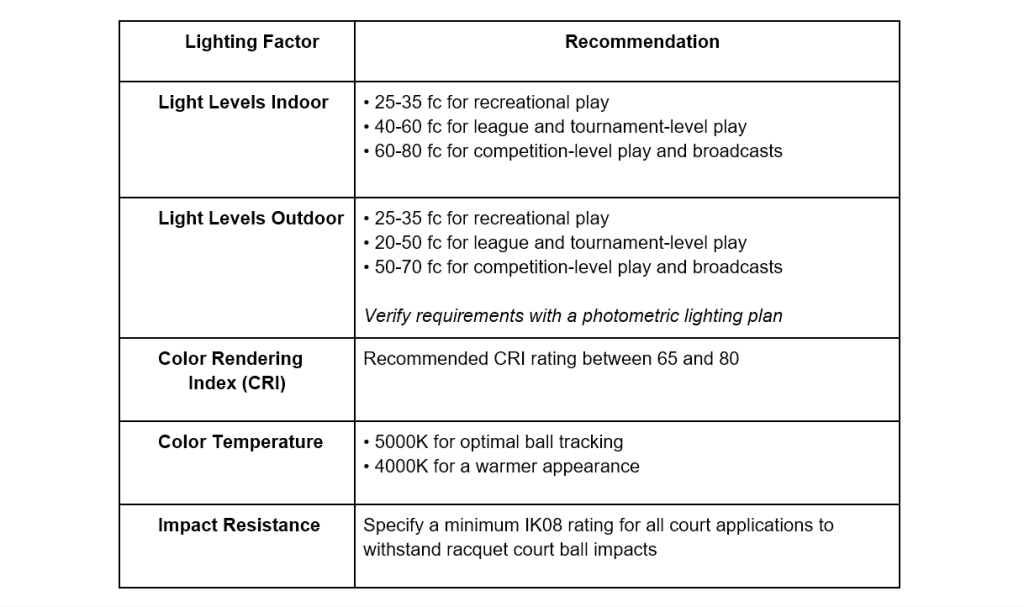
Additional Details to Consider
How to Get Started
Before engaging a lighting supplier, determine the court type (indoor or outdoor), dimensions, layout, ceiling surface material, and height, and the intended competition level. This information will allow product specialists to generate a custom-tailored lighting plan with product recommendations. From there, a product specialist will work with you to help you understand indirect and direct lighting in detail, so you can make a confident decision in your investment. Consulting with a lighting partner who understands the specific demands of pickleball play ensures a smooth project process and result.
About the author
Cory Peterson is Vice President of Marketing & Sales Operations at LED Lighting Supply, where he focuses on improving customer experience and revenue operations. Cory writes about commercial & industrial lighting, along with topics important to contractors and facility managers. In his free time, Cory enjoys traveling, snorkeling, exercising, and cooking.
LED Lighting Supply is a commercial, industrial, and sports project lighting, fan, and pole manufacturer and supplier. They partner with their customers to ensure the perfect solution for your project with exceptional product and post-purchase support. LED Lighting Supply’s product specialists can provide a lighting plan with product recommendations at no extra cost to ensure the requirements of a space are met.
DarkSky International. DarkSky. darksky.org
“LED Lighting Supply: Pickleball Court Lighting Done Right! (Choosing the Best Lights).” YouTube, youtube.com/watch?v=jwIZYqc2Mts. 2026.
LED Lighting Supply. (n.d.). LED Lighting Supply. ledlightingsupply.com
“Lighting.” USA Pickleball, USA Pickleball, usapickleball.org