Beyond the Catalog
How the lighting representative role is being redefined
By Paul Rodenbush, LC
Something is shifting in the lighting industry and it’s not just the technology.
For decades, the lighting representative role was largely defined by what you carried: your line cards, your product knowledge, your manufacturer relationships. Represent the lines. Support the specifications. Help move products from design through procurement. It was a model that worked well for a long time — but it doesn’t work the same way anymore.
Over the past year, I’ve had conversations with designers, contractors, specifiers, manufacturers, distributors, and fellow reps that all point to the same conclusion: the role is changing, the pressure is real, and the industry is still working out what comes next.
I’ve been in lighting long enough to have felt that change firsthand, including years as a lighting agent. What follows is what I’ve observed and what the people closest to these projects are increasingly saying out loud.
From Fixtures to Ecosystems
Victor Menendez, President at EX Design Group and a seasoned consultant, framed the transformation with an analogy I haven’t been able to shake: “Lighting got reinvented the same way the typewriter industry did. It used to be all about the source: incandescent, mercury vapor, MR16s, fluorescent, filaments. Today, lighting is basically a semiconductor and controls industry.”
For most of lighting’s history, the fixture was the product. You specified it, procured it, installed it. The conversation was relatively self-contained. That model is fading fast.
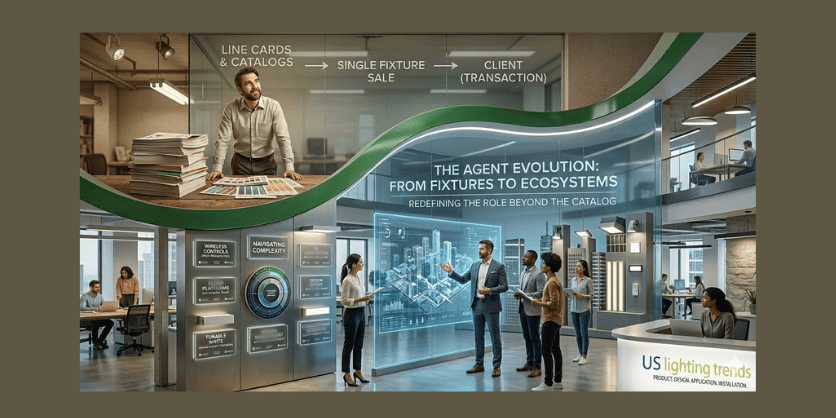
Today, controls, drivers, wireless networks, cloud platforms, dimming protocols, tunable white systems, circadian strategies, and energy management are all part of the same conversation and they all have to work together. The future value in lighting increasingly lives in the ecosystem, not just the fixture. Who controls the environment matters more than who simply supplied the luminaire.
For anyone representing lighting products, that’s a significant repositioning of where expertise needs to live.
The Technical Bar Has Risen
Kyle Lazor, Principal at Independence Lighting, put the pace of that change in perspective. More than 20 years ago, someone asked him why he needed to learn networking. At the time, it seemed completely unrelated to lighting.
“Fast forward to today,” he wrote, “and lighting reps are dealing with gateways, wireless controls, PoE networks, cloud platforms, commissioning, and remote diagnostics. The reps who continue learning beyond just fixtures and pricing are the ones bringing the most value to projects.”
I felt this shift personally. The questions being asked of me as a rep changed steadily over time. Contractors wanted to understand commissioning sequences. Owners asked how systems would be managed after occupancy. Designers wanted confidence that the control strategy would actually deliver what the specification described.
The rep who could only discuss fixtures wasn’t excluded from those conversations; they just couldn’t contribute to them.
What the Title No Longer Captures
Christopher Scerra, a business development professional with years in the industry, made a point worth considering: he’s never been comfortable with the title “lighting representative.”
In his view, many of the most effective practitioners have already evolved into something closer to Lighting Specialists and the distinction matters. “Representative” implies a transactional role: you speak for a manufacturer, move product, support a sale. “Specialist” suggests judgment, depth, and the ability to advise rather than simply supply.
That’s not just semantics. It reflects what clients are increasingly asking for.
Where Projects Quietly Break Down
Here’s something I observed repeatedly during my years as a rep: the biggest project failures rarely started with a bad fixture. They started in the gaps between design intent and budget, between specification and procurement, between what was promised and what ultimately got built.
Specifications rarely collapse overnight. They erode — a substitution here, a value-engineering conversation there, an “equivalent” product introduced late in the process. By the time someone notices the design intent has drifted, it’s often too late to correct without disruption.
The rep who understands this dynamic brings a different kind of value, one less about the product itself and more about protecting the project.
• Identifying vulnerable specifications early.
• Surfacing alternates before conversations become reactive.
• Helping teams stay aligned when schedule and budget begin pulling in different directions.
That’s consultative work, not transactional work. And increasingly, it’s what clients actually need.
AI Is Entering the Conversation
Nelson Duder, co-founder of Lighting Innovation, noted that AI is already reshaping specification sales, “building on the foundation of Speed, Trust and Accuracy.” That feels like an accurate read of where the industry is heading.
AI won’t replace experienced lighting professionals, but it will raise the floor on responsiveness and information access. Searching specifications, identifying alternates, summarizing product data, drafting responses, tasks that once consumed significant time will become faster and more consistent.
The professionals who adopt these tools effectively will free up more capacity for the work that genuinely requires human judgment.
And that judgment still matters.
• Understanding why a designer made a specific choice and what a substitution truly costs beyond the price delta.
• Knowing which “equivalent” product creates installation problems six months later.
• Recognizing when a control strategy is heading toward a commissioning failure before anyone else in the room sees it.
Those things come from years of being on projects, making mistakes, solving problems, and paying attention.
AI can support that experience. It cannot replace it.
What the Next Generation of Reps Will Look Like
The lighting professional who thrives in the next decade will likely look different from the one who thrived in the last one — but not entirely.
The technical fluency required today extends well beyond fixture specifications. Controls, networking, commissioning, system integration, these are becoming table stakes, not differentiators.
The professionals who stand out will be the ones who can move information quickly and accurately across project teams under time pressure while thinking beyond the immediate transaction toward the broader project outcome.
But the foundation of the role hasn’t changed.
In an industry where product information is increasingly available to everyone, credibility, follow-through, judgment, and trust remain the things that determine who gets called when something truly matters.
The lighting industry has always evolved through technology, from incandescent to LED, from standalone fixtures to integrated systems. What feels different now is that the next evolution may be less about the light source itself and more about the people helping clients navigate increasing complexity around it.
The professionals who define the next era of this industry likely won’t be remembered simply for the lines they carried.
They’ll be remembered for what they helped their clients successfully navigate.
About the author
Paul Rodenbush, LC is an architectural lighting professional focused on design, product, and project execution. Click here to share your thoughts with Paul, or here to connect with him on LI.
And if you’d like to share your thoughts on the future of lighting agents and the role they play in the US lighting ecosystem, send us a note … or feel free to write an article and we’ll publish it.
Related articles
NEMRA Lighting Launches Inaugural Lighting Summit
Why Lighting Reps Carry So Many Lines: Understanding the Multi-Line Strategy in Today’s Market