
MeshConnect Gives OEMs an Agnostic & Scalable Path to Lighting Controls
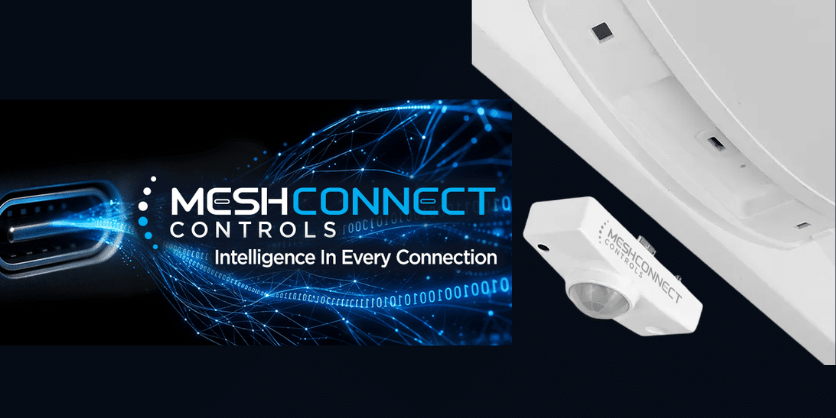
The next phase of the industry’s evolution centers on the new capabilities that connected controls, like those from MeshConnect, provide.
Umesh Baheti, Managing Director of MeshConnect, explains how the independently operated controls technology company is providing lighting OEMs with a flexible, production-ready platform designed to help them participate in the growing connected-lighting market. With the recent appointment of Jeff Bristol as Chief Commercial Officer, MeshConnect is also building the commercial organization needed to expand adoption among OEM fixture manufacturers.
Lighting manufacturers have spent the past decade navigating the transition from legacy light sources to LED. The next phase of that evolution is less about the fixture itself and more about what the fixture can do once it becomes connected.
As energy codes, building standards and customer expectations drive demand for lighting controls, OEMs face a strategic question: How can they participate in the growing controls opportunity without the capital, engineering and infrastructure required to develop and maintain their own controls offering?
MeshConnect believes there is another path.
MeshConnect is an independently operated controls and connected-technology company providing OEM fixture manufacturers with scalable, production-ready technology that can be incorporated into luminaires and other smart devices. It owns patented connector technology, and because it does not manufacture or sell fixtures of its own, it competes with none of the manufacturers it serves. For an OEM, that means adopting sophisticated controls while keeping full ownership of its brand, its customers and its product line.
“Controls have gone from optional to essential,” said Umesh Baheti, Managing Director of MeshConnect. “But adoption is still early, and that’s the opportunity. It’s a growth category, and manufacturers of all sizes want to get in.”
A Controls Platform Built for OEMs
Building a controls capability involves far more than hardware. It requires software, firmware, engineering talent, testing, certifications, interoperability, technology partnerships and ongoing development. For manufacturers without deep controls resources, or those that would simply rather invest elsewhere, that’s a heavy lift.
MeshConnect removes it. OEMs adopt a platform that is already engineered, certified and in production, bringing control capabilities to market far faster than they could build them — and with little R&D cost.
“We’re not saying to an OEM that they shouldn’t build controls on their own. If they want to, great,” Baheti said. “But we have done it, at our scale, and it’s not inexpensive to develop. We’ve turned it into something a manufacturer can simply adopt.”
The approach can be particularly relevant for manufacturers in architectural, decorative, outdoor and specialty lighting categories that may want a faster path to a broad range of controls rather than a controls operation of their own.
“Our focus is to empower OEMs that want a faster path to controls, while they keep their brand and their customer relationships,” Baheti said.

One Connector, Many Options
At the center of the MeshConnect platform is its patented USB-C connection technology, which provides a simple interface between the luminaire and compatible controls hardware. The receptacle is integrated into the fixture, so a control device can be added, or swapped for a different technology, by plugging it in, with no rewiring and no pulling the luminaire from the ceiling.
That one connector opens a menu of choices as technologies and project requirements evolve. Depending on the application and form factor, it can support a variety of protocols including BLE, proprietary Bluetooth, Bluetooth NLC, Sub-GHz and DALI-2.
“We didn’t invent USB-C but with this port, we’ve made it easy to add a variety of controls technologies, and that’s what makes us unique,” Baheti said.
MeshConnect brings capabilities ranging from basic stand-alone sensing to advanced networked controls that can connect with building management systems. It integrates with advanced network partners including Autani, Casambi and Silvair.
“There is no single controls technology that is ideal for every project,” Baheti said. “Our approach allows OEMs to select the right solution for the application while maintaining flexibility for the future.”
“We have created a fantastic ecosystem of partners that we develop technology with,” Baheti explained. “We are building intelligence into our hardware and making this completely seamless for the end-user.”
The platform has already moved beyond the concept stage and into real-world deployment across commercial projects.
From Lighting Controls to Connected Buildings
MeshConnect sees the opportunity to extend beyond traditional lighting controls.
Because lighting fixtures are distributed throughout virtually every commercial building, they can provide an infrastructure for a broader range of connected-building applications. Sensors already used for dimming, scheduling and color control, for example, can potentially provide environmental information such as temperature and humidity.
“Think about how a sensor that today is being used for dimming, scheduling and color control could also provide environmental information around temperature and humidity,” Baheti said. “That data can support HVAC and other building systems, creating opportunities for lighting manufacturers to participate in the broader intelligent building ecosystem.”
“Ten years ago, people were talking about LED conversion, and energy savings was the big play,” he added. “Now it’s increasingly about data and how we are going to use lighting beyond the need of just lighting.”
For OEMs, this shift positions controls as more than a fixture feature. It becomes a path to a broader addressable market.
Turning a Controls Requirement Into a Growth Opportunity
Controls are increasingly written into project requirements across commercial lighting: retrofits meeting updated codes, new construction specifying particular platforms, design-build contractors seeking integrated solutions, value-engineering opening the door to alternative architectures. Access to a ready controls platform lets an OEM pursue projects it might not have been positioned to win before.
“This gives manufacturers the ability to start playing in opportunities where they may not traditionally have been invited,” Baheti said.
The alternative can be harder. Developing a proprietary platform requires substantial investment and specialized talent, while relying exclusively on a single major controls provider can limit options when projects call for a different technology or architecture.
MeshConnect offers another route that OEMs can incorporate into their existing product strategies and expand over time.
“We are giving OEMs a production-ready controls platform,” Baheti said. “They can start with the capabilities they need today and expand as their business and market requirements change.”
Building the Commercial Organization
As MeshConnect expands its market presence, the company has appointed Jeff Bristol as Chief Commercial Officer to lead its commercial strategy and build the organization responsible for driving OEM adoption. Bristol brings leadership experience across the lighting, controls and OEM markets and will focus on developing MeshConnect’s commercial strategy, OEM relationships, and its go-to-market organization.
“My focus is on turning the market’s growing interest in controls into real adoption for our OEM partners,” Bristol said. “We want to be their technology and commercialization partner, helping them differentiate their products, respond to changing market requirements and bring intelligent, connected solutions to market faster.”
Bristol’s immediate priorities are onboarding new OEM partners and guiding manufacturers from initial technology evaluation through to product commercialization.
A Path to the Connected-Lighting Future
MeshConnect’s strategy is ultimately based on a simple premise: the future of connected lighting will be increasingly ecosystem-driven.
Technology and protocols are evolving too quickly for manufacturers to assume that one approach will remain ideal for every application. “Today’s technologies flex rapidly, so to commit to one technology could completely backfire,” Baheti stated. By pairing a common hardware interface with a range of technology options and partners, MeshConnect gives OEMs a way to move with that change instead of betting against it.
“It’s imperative that manufacturers are looking at solutions that are not only a good fit for today, but also for the future,” Baheti said. “Our vision is to make USB-C the industry-leading plug-and-play connector for lighting controls.”
For OEMs, that connector represents the larger prize: a scalable path into the growing controls and intelligent building market while maintaining ownership of their products, their brands and their customer relationships.
Related articles
MeshConnect Appoints Jeff Bristol as Chief Commercial Officer