Why Controls Get Cut, and How to Keep Them in Scope
By Chris Byerly, Director of Business Development, Chateau Energy Solutions
Anyone who has managed a commercial lighting retrofit knows exactly what gets cut when the budget comes in high, and controls will always be near the top of the list. The LED fixtures stay, and the occupancy sensors, scheduling and daylight harvesting go. The logic sounds reasonable enough: the LEDs deliver most of the savings, so the controls are just the icing on the cake.
However, our argument is different. Controls should not be evaluated as an all-or-nothing add-on after LED savings are established. The right time to decide how much control a facility needs, and where, is at the beginning of the lighting upgrade project, when the economics can be built around how the building actually runs.
This is not an argument for lighting controls at every job. We do not think every fixture needs a sensor, and plenty of applications are better served by a simpler system. Some are even better off with no controls at all. This is about distinguishing when controls are necessary and when they are, in fact, surplus to needs.
Why lighting controls get cut
Cost is the stated reason, and it is usually the real one. But cost often carries a second concern underneath it: complexity. Owners remember control systems from 10 or 15 years ago that required extensive hard wiring, a cabinet of separate components, one specialist to program them and another to fix them. That version of controls earned its reputation as being a beast to deal with and repair over time.
But that position is no longer applicable, because it does not describe most of what is available today. Many current lighting control systems are wireless or integrated directly into the fixture, which removes a large share of the wiring and labor that used to drive up the price. Routine changes can now easily be made with a remote or an app rather than a service call. For an owner working with an experienced lighting retrofit partner, commissioning belongs to the project team, not the facility staff.
A knowledge gap in the market works against everyone
Not every contractor or project team installs the newest controls regularly, so some still describe and price them based on older solutions. The customer hears complicated and expensive and makes a perfectly rational decision on bad information.
To be fair, not every controls solution is cheaper or simpler. Applications that still require hard wiring or a more sophisticated architecture can add real cost to a job. The point is to price the technology that exists now, for the specific application, rather than assume.
Where lighting controls earn their place
Lighting controls make the most sense where occupancy is inconsistent, where areas sit empty for stretches of the day, and where light levels can fluctuate without anyone noticing. A continuously occupied production line with strict light-level requirements for safety or process is a different opportunity than the warehouse aisle on the other side of the wall.
Manufacturing, industrial, warehouse, and distribution facilities tend to be a great fit for controls, and not simply because they use a lot of lighting, but because they rarely use every part of a large building the same way at the same time. Large square footage, high-bay fixtures, extended or 24/7 hours and predictable shift patterns, skylights and clerestories, and sharp variation in activity from zone to zone all compound.
A building being open does not mean every light needs to run at full output every hour. Occupancy sensing is usually where most of the savings live, and dimming rather than hard on-off keeps the change from being too disruptive.
A real project: what the numbers showed
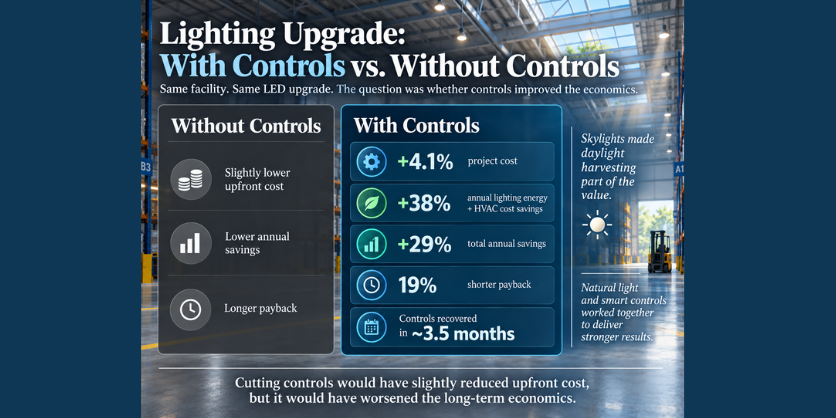
Medline Industries, a manufacturer and distributor we recently worked with, makes the point better than any general rule. The facility had skylights, a strong signal that daylight harvesting would add meaningful value on top of occupancy sensing. We ran the full analysis: same project, same scope, with controls versus without.
Adding controls increased the installed project cost by 4.1 percent. In return, annual lighting energy and HVAC savings improved by approximately 38 percent. Overall annual cost savings improved by 29 percent, and the simple payback period shortened by roughly 19 percent. Viewed as an incremental investment, the added cost of the controls was recovered in approximately three and a half months.
Cutting controls would have slightly trimmed the upfront cost and meaningfully worsened the long-term economics. The modest premium paid for itself in a single quarter.
“We had done LED retrofits before and generally viewed controls as an extra cost. Chateau Energy took the time to walk us through the economics for this facility rather than simply recommending more equipment,” said Ryan Pike, Medline Industries, Sr. Maintenance Manager – Facilities Maintenance. “The numbers showed us that controls made sense here, especially with the skylights and the opportunity for daylight harvesting. The return was much faster than we expected, which made the decision became much easier.”
Adding controls later is rarely realistic
Another angle we sometimes get from facility operations teams is whether they can design for controls now and add them later. In practice, that almost never happens. Once the lighting fixtures are up, going back means labor, lift rentals, and disruption on the floor — and that erases the case.
The only workable option is to install inexpensive fixture-integrated controls during the retrofit and leave them dormant until the facility is ready to use them. Installation time follows the same logic. Some applications add nothing to labor at all — daylight sensors mounted on fixtures that are going up anyway are the obvious example.
What to change
If we could change one thing about how owners evaluate controls, it would be timing. Decide the level of control by zone, early, with the full economics in front of you: utility rates, operating hours, available incentives, and the incremental cost of the technology available today. Sometimes the answer is a full controls package. Sometimes the answer is sensors in the warehouse and nothing on the production floor. And sometimes the answer is no controls. All three are defensible. Leaving it to the last line of the budget is not.
_______________________________________________________________________________________________
Chateau Energy Solutions delivers turnkey lighting upgrades and retrofits for industrial, warehouse, healthcare, commercial, and retail facilities nationwide, including audits, design, controls, rebate administration, and Energy-as-a-Service financing. Learn more at https://chateaues.com/energy-efficiency-solutions/lighting-upgrades-retrofits/ or contact us at info@ChateauES.com.