

New Report Shows Shortage of Electricians & Other Trades Will Lead to Critical Economic Shortfalls by 2030

Bring Back the Trades will be hosting a virtual webinar on Wednesday, February 11 from 10:30am-11:30am to discuss the findings of the study and what it means for regional and the national economies.
The organization Bring Back the Trades Inc., together with F.W. Webb Co., released a landmark economic impact report that sounds the alarm on the skilled trades shortage across the U.S., and every state in the country.
The analysis reveals the dire cost of inaction: the projected skilled trades gap includes 1.4 million jobs unfilled in just seven trade categories by 2030. This deficit represents an estimated $325.6 billion in lost GDP nationally each year. The shortfall also results in approximately $71.3 billion in lost federal, state, and local tax revenue.
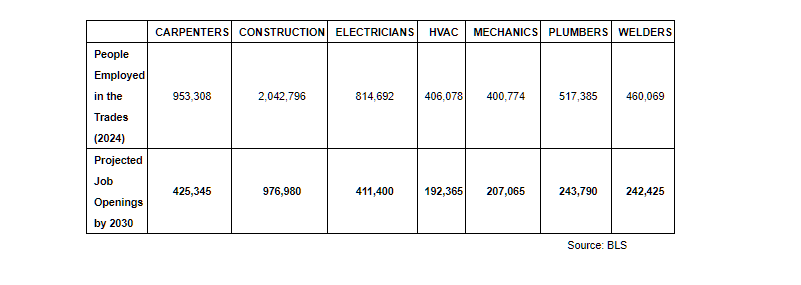
The seven trades analyzed – electricians, mechanics, plumbers, welders, construction, HVAC, and carpenters – consist of 5.6 million total jobs nationwide. Together, they generate $1.3 trillion in annual economic impact.
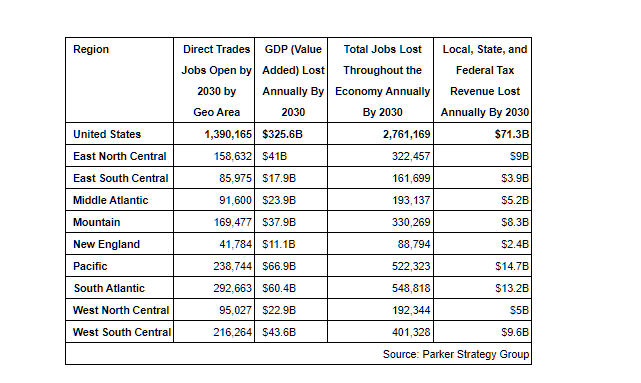
The report quantifies the skilled trades workforce gap across these essential occupations, detailing both national economic impacts and a focused breakout analysis for every U.S. region. While the skilled trades shortage is a national issue affecting communities in every state, some regions face especially acute challenges driven by an aging workforce, rising demand, and a limited pipeline of new skilled workers. (View the full report here and the technical report with full methodology here.)
“This isn’t just a report — it’s a call to action,” said Steve Turner, founder and CEO of Bring Back the Trades. “The shortage in the skilled trades impacts every sector of our economy. We must act now to fill the current need, and share solutions on how to empower the next generation of skilled workers.”
To give stakeholders, policymakers, and the public a deeper dive into this data, Bring Back the Trades will be hosting a virtual webinar on Wednesday, February 11 from 10:30am-11:30am to discuss the findings of the study and what it means for regional and the national economies. Use this link to preregister and receive further information on how to attend this webinar.
The research was sponsored by F.W. Webb Company, a third-generation, family-owned company that is the largest wholesale distributor of plumbing, heating, HVAC, LP gas, refrigeration, pipe, valves and fittings in the Northeast.
“F.W. Webb is proud to support this work because solving the skilled trades shortage requires real data and real collaboration,” said Sean Davis, Vice President of Marketing at F.W. Webb Company. “By quantifying the economic impact of the gap, this report gives leaders, educators, and employers the insight they need to take meaningful action. The stakes are high, and together we can ensure America has the skilled workforce it needs to thrive.”
Parker Strategy Group, a national consulting firm, was secured by Bring Back the Trades to quantify the economic impact of the projected job deficit. Their analysis shows how the workforce shortage is creating ripple effects across industries using jobs data the University of New Hampshire pulled from Department of Labor sources.
“Closing the skilled trades gap is not just about filling jobs — it’s about sustaining industries, strengthening communities, and creating opportunities for the next generation,” added Shana Brunye, COO and Research Director at Bring Back the Trades. “Our national and regional analysis shows just how urgent this challenge is, and how much is at stake if we don’t act.”
“Across the United States, the shortage of electricians, welders, plumbers, and other skilled workers is more than a workforce issue — it’s an economic imperative,” said Nichole Parker, Managing Principal of Parker Strategy Group. “By analyzing the baseline and gap impact of these seven core trades, we’re equipping leaders with the evidence they need to start to reverse the trend and build a stronger future.”
According to Bring Back the Trades, the time to act to address the issue is now.
“[We are] issuing an urgent, national call to action,” Turner said. “We challenge students, families, educators, employers, and policymakers to recognize this economic imperative. We must mobilize now to invest in expanded training pathways and inspire the next generation to pursue these essential careers that keep America’s economy strong.”
Ongoing research, supported by F.W. Webb, will continue through 2027 to assess projected impacts on additional trades.
“This foundational report, made possible by the generous support of F.W. Webb Company, is just the beginning of Bring Back the Trades’ commitment to data-driven advocacy,” Brunye noted. “We are already beginning another round of comprehensive research to tackle additional trade roles to help increase visibility on the opportunities in the skilled workforce across the country today and into the future.”