Beyond Energy Savings: Why Municipal Lighting Is Moving Toward Solar
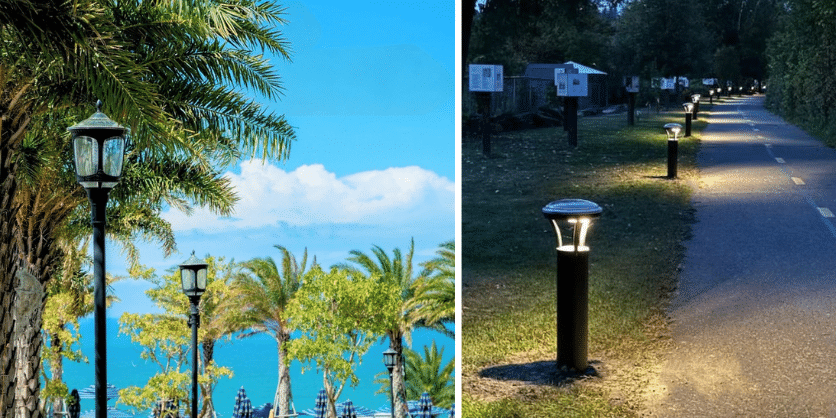
In addition to a host of other benefits over conventional fixtures, solar lighting continues to evolve in aesthetics to the point where it can now fit in seamlessly with many historic downtown areas.
By Tahlia Helmreich | Star LED
From eliminating trenching and simplifying installation to preserving the character of historic Main Streets and revitalizing downtowns, advances in solar lighting are changing how communities approach public lighting infrastructure.
Historically, municipal solar lighting was discussed primarily in terms of renewable energy and electricity savings. Today, the conversation is much broader.
When a municipality needs to illuminate a park, roadway, parking area, trail or historic downtown streetscape, the question increasingly becomes: Do we actually need to bring electrical infrastructure to this location at all?
The Hidden Infrastructure Behind a Conventional Light
Conventional wired lighting has long been the backbone of municipal lighting. But behind every fixture is infrastructure that can add significant cost, complexity and time to a project.
When lighting can be successfully delivered off-grid, municipalities can avoid or substantially reduce trenching, conduit, cabling, electrical work, pavement and landscape restoration, utility coordination and the ongoing cost of grid consumption.
Retrofitting existing electrical infrastructure will often make sense. The equation begins to change, however, when communities need to add or expand lighting into areas without readily available power, or when aging electrical infrastructure requires significant work before new lighting can be installed.
Permitting, planning, utility coordination and infrastructure upgrades can turn what appears to be a relatively simple lighting project into a much larger undertaking.
This is why solar can make sense even before electricity savings are calculated.
Installation can also become substantially less disruptive. In appropriate applications, municipal crews can install complete solar lighting systems without bringing electrical service to every pole. With no underground electrical connection between fixtures, projects can move from installation to operation remarkably quickly.
Solar Technology Has Caught Up With Municipal Requirements
Then there is resilience.
Solar lighting is no longer simply a fallback for locations where grid power isn’t available. It has become a viable everyday infrastructure option — and one that deserves consideration when municipalities plan both day-to-day and emergency lighting.
A properly designed autonomous system can continue operating independently of the electrical grid during outages caused by storms, damaged infrastructure or other disruptions. It also eliminates underground copper wiring between the electrical supply and light pole, removing one common target for copper theft.
The objective is remarkably simple: light when the community needs it.
And this isn’t the solar lighting many people remember from 10 or 15 years ago. Advances in battery technology, LED efficacy, intelligent controllers, optical performance, solar collection and sophisticated operating profiles have significantly changed what can be accomplished off-grid.
Solar technology has matured to the point where municipalities can increasingly evaluate it as infrastructure rather than novelty.
The Remaining Challenge for Downtowns: Appearance
Historic downtowns and Main Streets are places where many of solar lighting’s practical benefits become particularly attractive.
These are established environments filled with sidewalks, underground utilities, landscaping, businesses, pedestrian activity and existing infrastructure. Excavating a mature downtown streetscape to extend electrical service can create disruption well beyond the lighting project itself.
But historically, solar presented another problem: It looked solar.
Large visible panels and highly contemporary fixtures don’t necessarily belong alongside historic façades, traditional street furniture and carefully preserved streetscapes.
Thoughtfully planned lighting should complement its surroundings, create ambiance and contribute to the identity of a district rather than distract from it.
A downtown light spends roughly half its life switched off. It still needs to belong there.
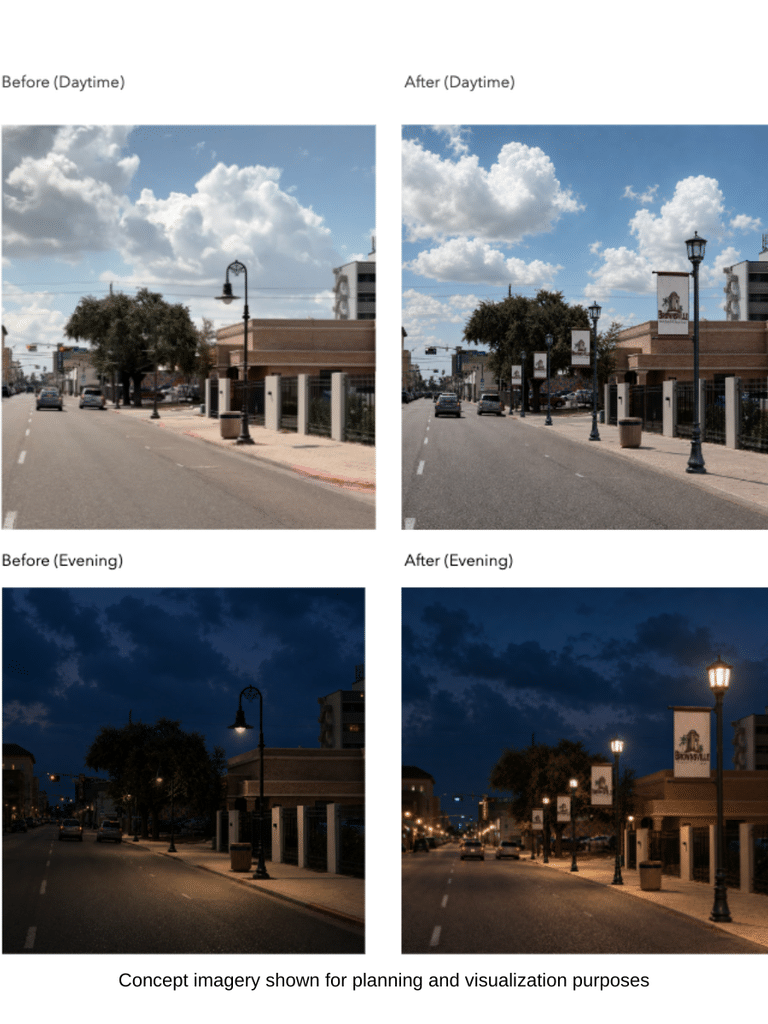
Historic Downtowns Don’t Have to Look Solar
This is perhaps one of the most exciting developments in solar lighting.
It doesn’t just work better. It can look better, too.
Traditional post-tops, pedestrian-scale luminaires, bollards and other decorative forms can now incorporate solar technology in ways that allow communities to preserve an established architectural character while gaining the advantages of off-grid infrastructure.
The goal isn’t to disguise technology simply for the sake of hiding it.
It’s to allow the technology to adapt to the community rather than asking the community to adapt to the technology.
Through our work with Main Street programs and downtown organizations, we’ve seen how important it is for infrastructure improvements to support – not compete with – the character communities are working so hard to preserve. Lighting is a particularly visible part of that equation. The right solution needs to perform after dark while still contributing to the identity of the streetscape during the day.
That distinction matters in historic districts, Main Streets and downtown revitalization projects where lighting is not simply a functional asset. It becomes part of the streetscape itself.
One Solar Strategy Can Address Much More of a Downtown
The conversation is also moving beyond the installation of an isolated solar fixture.
A coordinated solar lighting strategy can address multiple elements of the public realm: historic streetscapes and decorative post-tops, pedestrian areas and plazas, murals and alleyways, roadways, parking areas, parks, pathways and trails, bollards, gathering spaces and other public areas.
For communities, that creates an opportunity to think about solar lighting at a district level rather than simply fixture by fixture.
This is where our work at Star LED has become particularly interesting: looking at the entire public-space lighting environment and determining where different solar technologies can meet functional requirements while maintaining an intentional and cohesive visual language.
A roadway doesn’t have the same lighting requirements as a plaza. A pedestrian pathway doesn’t require the same solution as a parking area. And a historic Main Street should not necessarily look like any of them.
The technology can change while the character of the community remains.
Solar Isn’t Automatically the Answer
None of this means every municipal light should become solar.
A considered approach is important, and working with professionals who understand both municipal lighting requirements and autonomous solar systems is essential.
Site conditions matter. Solar exposure matters. Photometric requirements matter. Operating profiles, required autonomy, climate, mounting conditions and surrounding architecture all matter.
Existing grid infrastructure may make conventional lighting the appropriate solution in one location, while the cost and disruption of extending that infrastructure may make solar significantly more practical somewhere else.
The better question isn’t: “Can we replace every grid-connected light with solar?”
It’s: “Where does eliminating the grid make better infrastructure sense?”
Where Municipal Lighting Is Heading
Municipal solar lighting isn’t simply about generating electricity differently anymore. Nor is its value limited to avoiding an ongoing electric bill.
It’s increasingly about deploying infrastructure differently.
For municipalities, that can mean fewer underground electrical requirements, less disruption to established spaces, faster deployment, greater independence from the electrical grid and new possibilities for bringing lighting to locations that have historically been difficult or expensive to serve.
And for downtowns and Main Streets, technological progress means communities no longer necessarily have to choose between those practical advantages and the character of the place they’re trying to preserve.
The future of municipal solar lighting may not be defined by how visibly “solar” a fixture looks.
In many communities, success may mean exactly the opposite: infrastructure that delivers the benefits of solar while looking as though it has always belonged there.
_______________________________________________________________
About the Author
Tahlia Helmreich is the Director of Sales & Contracts at Star LED, a municipal lighting company specializing in solar and LED infrastructure for communities across the United States. Star LED is an Allied Member of Main Street America and works with municipalities and downtown organizations to develop lighting solutions for streetscapes, parks, pathways, public spaces and historic downtown environments.