
Can AI Help Everyone at the Table Make Better Decisions?

AI can organize the comparison; the project team must interpret the tradeoffs.
By Paul Rodenbush, LC
A distributor, contractor, or competing lighting agent proposes an alternate that looks equal on paper — similar lumens, similar wattage, and a better price.
Each may be doing exactly what their role requires: offering a represented product, improving availability, or finding a way to bring the project within budget.
We often call this value engineering. But an alternate does not create value simply because the number went down.
Months after installation, the facility team discovers that the dimming performance does not match the rest of the space. Somewhere between the original specification and the final installation, something changed, but nobody has a complete record of when, why, or who approved it. That gap, between “the product crosses” and “the decision was good” is where this conversation begins.
Every person at the project table is working from a different definition of a good decision.
The owner may be focused on budget, schedule, and long-term value.
The architect is protecting their vision.
The lighting designer is thinking about visual experience and design intent.
The engineer is responsible for code, power, controls, and coordination.
The contractor must turn the design into something that can be estimated, procured, and built within budget.
The facility team is considering maintenance.
The distributor is managing pricing, availability, and logistics.
The manufacturer and lighting representative are evaluating whether the specified solution – or a proposed alternate – will perform as expected, while each participant also works within their own commercial responsibilities.
Everyone has different responsibilities, incentives, and customers — but the shared goal should be delivering the best possible outcome for the owner.
Yet the owner has a different responsibility from all the others. It is the owner’s investment. The specifier can explain what may be gained or lost. The contractor can explain cost and constructability. The facility team can identify long-term operational concerns. Manufacturers and representatives can provide product knowledge and technical support.
But ultimately, only the owner can decide which tradeoffs are acceptable.
Artificial intelligence can process information from all those perspectives. But can it help everyone at the table make a better decision together?
More Information Does Not Always Mean Better Decisions
The lighting industry does not suffer from a lack of information. We have photometric files, specification sheets, BIM models, energy calculations, control narratives, pricing, lead-time reports, submittals, installation instructions, and maintenance requirements.
The challenge is that this information exists in various places, reaches different people at separate times, and is interpreted according to each participant’s responsibilities.
A product substitution may appear to generate savings, but what else has changed?
Distribution, control protocol, ceiling condition, serviceability, lead time, installation, and design intent — any one of those can change quietly behind a number that only went down.
Those answers may exist, but they are rarely presented together.
This is where AI can become valuable, not as the decision-maker, but as a tool for identifying connections and consequences that are easy to miss.
Who Should Control the Comparison?
For AI to provide a genuinely balanced view, the comparison needs to be controlled by the owner, or by the specifier acting on the owner’s behalf.
Perhaps the specifier should also serve as the custodian of the lighting decision record, with both the authority and accountability to document how each proposed change affects the original intent.
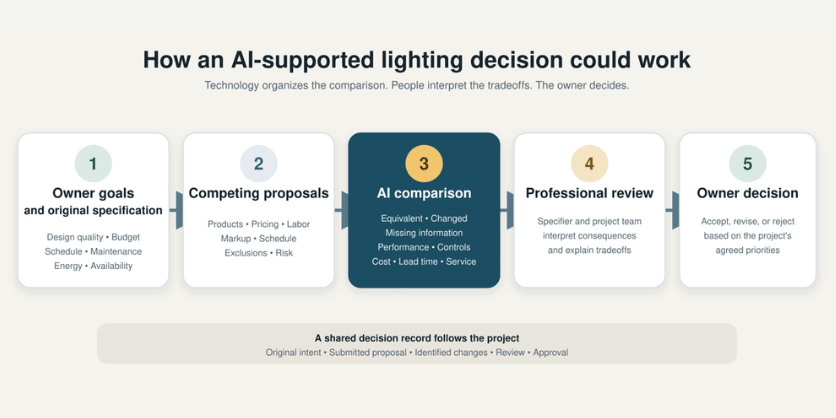
Any such process should begin by setting up the project’s original goals.
What matters most? Design quality? First cost? Energy performance? Speed of installation? Long-term maintenance? Product availability?
Projects prioritize these factors differently based on the owner and application.
The original specifications and competing proposals can then be uploaded and evaluated against those goals.
That distinction matters. A manufacturer, distributor, representative, or contractor will naturally use tools built around the products, pricing, and information available to them. That does not make the information wrong, but it may make the view incomplete.
For example, an agency’s system may suggest alternatives from the manufacturers it represents while overlooking competing products outside its line card.
The contractor’s proposal must also be considered as it was submitted, including equipment cost, labor implications, markup, schedule, exclusions, and risk. Comparing manufacturer data alone would not show the owner the complete financial or operational effect of the decision.
A useful system would not merely ask:
“Does this product cross?”
It would ask:
“How does this complete proposal compare with the original specification and the owner’s priorities?”
Seeing the Complete Decision
Imagine a platform containing the project’s original design criteria, fixture schedule, control narrative, energy goals, budget, schedule, and maintenance expectations.
When a competing proposal is submitted, AI could compare it with the original specification across optical performance, controls compatibility, dimensions, installation requirements, energy use, lead time, warranty, serviceability, and cost.
It could identify what remained equivalent, what changed, what information was missing, and which tradeoffs required professional review.
The owner might see a meaningful cost reduction. The contractor might see improved availability or easier installation. The distributor might see a product that can be sourced more reliably.
But the lighting designer might see a change in optical performance. The engineer might identify a conflict with controls. The architect might see a coordination issue. The facility team might inherit a product that is more difficult to maintain.
Consider this an owner-driven RFP process supported by AI: a system that analyzes competing proposals, identifies the differences, and flags where each submission aligns with – or departs from – the owner’s original or most recently approved requirements.
Today, those concerns often surface separately, and sometimes only after a decision has effectively been made.
AI can help bring them together earlier.
It would not approve or reject the alternate. It would create a common decision record that the owner and project team could review together.
That would not eliminate disagreement. It would make the disagreement more informed.
The goal is not simply to reach an answer faster. It is to understand the tradeoffs before the project becomes committed to a direction.
Pieces of the System Already Exist
The industry is not starting from zero.
Parspec, led by co-founder and CEO Forest Flager, is using AI to read fixture schedules, organize product data, identify alternates, develop quotations, and automate submittal packages. Its agency-facing tools help representatives search their line cards and evaluate potential crosses more efficiently.
Electrify Connect is building the manufacturer-side foundation that any broader AI-supported comparison process would require. Its platform helps manufacturers structure and maintain product configurations, specifications, pricing, quotations, submittals, and live catalog information in one connected system, making that information more current, consistent, and usable by AI.
Jerry Chen, co-founder and CEO of Electrify Connect, believes reliable AI-supported comparisons begin with current information coming directly from manufacturers:
“For AI to trust the freshness of the data, it must come directly from the manufacturer. A static specification sheet is outdated the moment it is published. Manufacturers need an operating platform that maintains their configurable products, SKUs, specifications, and prices, and then dynamically feeds that information to every touchpoint.
I would question the premise that AI should be unbiased. AI should favor manufacturers with better data. The AI equivalent of marketing is data structure, freshness, and accessibility. AI wants good data, and it is up to manufacturers to adapt accordingly.”
But accurate and accessible manufacturer information is only one part of the challenge. The industry also needs professionals who know how to question, interpret, and apply what AI produces.
Beatrice Witzgall, Dipl. Ing. Arch | M.Arch., is a Fractional GTM & Product Leader and award-winning designer at In3Design. She sees gaps in both industry knowledge and data readiness:
“AI is one of the most transformational technologies of our time, but the output is only as good as the input, and right now, our industry has a gap on both sides.
Many professionals who know how to evaluate a specification are not yet using these tools, while many who use them fluently do not always know what to look for. Closing that gap leads to better decisions, not just faster ones.
There is also a significant data-readiness gap. Much of manufacturers’ information, from specification sheets and drawings to price lists, is not AI-ready. AI may therefore surface the information it can access and interpret most easily, rather than the information that is most accurate or relevant. That creates an uneven playing field the industry needs to address.”
Other platforms are approaching the process from different directions. Lightsearch is developing an AI-powered platform that allows lighting professionals to search across manufacturers and compare product information. LightAZ enables specifiers to search and compare luminaires, configure products, and build fixture schedules and specification packages.
Outside of lighting, construction platforms such as Procore are connecting specifications, drawings, submittals, estimating, contracts, and bid comparisons. AI is increasingly being used to identify discrepancies, uncover scope gaps, and organize project information.
These companies are examples rather than an exhaustive list. Each operates within an expanding and increasingly competitive technology landscape.
Together, these systems demonstrate that many of the necessary capabilities, structured manufacturer data, document analysis, product comparison, bid leveling, and discrepancy detection, are already developing.
What still is missing is a neutral, lighting-specific decision layer controlled by the owner or specifier. It would connect the original project goals, the design specification, the actual contractor proposals, and the consequences of each proposed change.
The technology may be closer than we think. The larger question may be who controls it, who supplies the information, and how the industry ensures that the comparison remains complete and credible.
What AI Cannot Decide
The most useful role for AI may not be providing answers. It may be helping project teams consistently ask the questions that experienced professionals know cannot be overlooked:
- What assumptions are behind the budget?
- Are the competing prices based on the same scope?
- What changed between the original specification and the proposed alternate?
- Which requirements are mandatory, and which are preferences?
- What has been excluded?
- Who will maintain the system five years after installation?
- Where is the team relying on incomplete or unverified information?
AI can make this experience more accessible across the project team, but it must be used carefully.
An AI system can organize incorrect information just as efficiently as correct information. It can present an answer confidently without understanding the project history, the client’s priorities, the reliability of a supplier, or the practical realities of the job site.
Even with access to every project document, AI cannot independently determine what “better” means.
The priorities established at the beginning of the project now have real tradeoffs attached. Is the best decision the lowest first cost? The strongest design outcome? The shortest lead time? The easiest installation? The lowest energy use? The product that will be easiest to maintain?
“Better” is not simply a product characteristic. It is a project decision. It is a human decision.
The owner must define the priorities and accept the tradeoffs. The specifier must explain what may happen to performance and design intent. The engineer, contractor, facility team, distributor, manufacturer, and representative must contribute information from their areas of responsibility and expertise.
AI can organize those perspectives and expose the consequences. It cannot relieve the people at the table, especially the owner, of responsibility for the final decision.
It also cannot replace trust.
Knowing that a product technically meets a written requirement is different from knowing whether it is the right product for this project, from this manufacturer, at this moment.
That distinction is where human experience remains essential.
Better Technology, or Better Collaboration?
AI will certainly make portions of the design, specification, pricing, submittal, and procurement process faster.
The more important question is whether it will make those processes better.
Used well, AI can reveal missing information, expose conflicts earlier, and give everyone greater visibility into the consequences of a decision.
Used poorly, it can accelerate decisions that have not been fully considered and create greater confidence in conclusions that still require professional judgment.
The lighting industry should not measure AI only by how much time it saves. We should also ask whether it helps us make more complete decisions, preserve design intent, reduce downstream surprises, and understand one another’s priorities.
AI does not need to replace anyone at the table to change the way the table works.
AI can show what changed.
Experienced professionals can explain why it matters.
And the owner can decide whether the tradeoff still serves the investment.
Perhaps AI’s greatest value will not be removing people from the table, but giving them more time to sit at it, face to face, at the beginning of the project, while priorities are still being defined and better decisions are still possible for them.
__________________________________________________________________________________________________
About the author
Paul Rodenbush, LC is an architectural lighting professional focused on design, product, and project execution. He can be reached at prodenbush@sk-assoc.com
Related articles by the author