
Remodeling by the Numbers — Who Plans to Spend on Projects in 2026

There is a lot of data floating around and it’s hard to figure out which numbers are the most important to the lighting industry.
There was good news – during the last week in February, Freddie Mac announced the average 30-year, fixed-rate mortgage dropped below 6% – which many experts predicted would mean home buying will soon ramp up.
This recent enthusiasm was soon tamped down, however, by the jobs report released on March 6 by the Bureau of Labor Statistics that revealed that – surprise! – the U.S. economy lost 92,000 jobs, leading to a rise in the unemployment rate. Days later, Federal Reserve Governor Stephen Miran told CNBC that those job losses could influence the central bank to consider another interest rate cut.
Despite the information overload, there remain two categories of home improvement spending that are never unaffected by economic fluctuations: repairs and maintenance. Other areas of home improvement spending are more fluid.
The Home Improvement Research Institute (HIRI) explored which home categories are expected to see the most traction in consumers’ discretionary spending in 2026. Although the details of its newly released 2025 Project Decision Study are only available to HIRI members, there are some broad strokes that the lighting industry can glean.
According to the stats presented in the Project Decision Study, electrical distributors can anticipate an increase in the number of smaller projects that homeowners are willing to undertake in 2026. This could include home improvements such as upgrading ceiling fans indoors or adding damp- and wet-rated ceiling fans outdoors to remodeled outdoor living spaces (a trend that shows no signs of slowing). It may indicate more homeowners and contractors coming into distributors for simple upgrades such as adding disk lights for areas with shallow-plenum ceilings, swapping out decorative pendants or a new fixture for over a kitchen island, or upgrading their dining area chandelier or exterior lights.
HIRI noted, “Despite a continued level of financial strain and tempered customer confidence to start 2026, the home improvement products market is expected to continue growing over the next few years.”
Most notably HIRI stated that most of customers’ big concerns regarding finances and the economy are holding steady — but there are reservations. Not surprising are the findings that the demographic planning the most – or largest – home improvement projects are those with full-time employed households. Retired homeowners ranked as the second-most represented demographic for those pursuing home renovations. However, the number of retirees planning major renovations is significantly less than the households with full-employed adults.
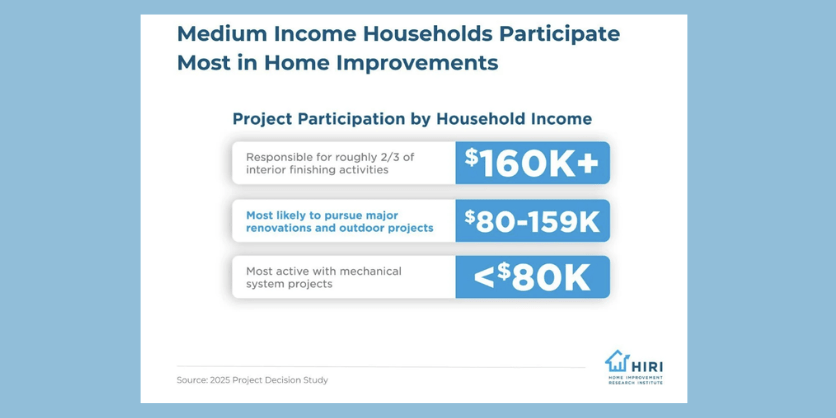
What are the magic numbers for opting to take on a home improvement project in 2026? About two-thirds of interior projects are done by households bringing in $160,000-plus, according to HIRI. The study also found that medium-income households ($80,000 to $159,000) are the most likely to pursue major renovations and outdoor projects, while those households making less than $80,000 are the most active with mechanical system projects.
Approximately half of homeowners surveyed expect to spend the same or more on home improvement in 2026 than they did last year. “While overall home improvement spending declined at the end of 2025, fewer completed projects led to higher spend per project, which implies tighter prioritization and deeper investment in essential or higher-value work. Intentions around home improvement spending seem to be steady at the start of 2026, signaling a measured and cautious outlook rather than retrenchment, with homeowners maintaining intent while calibrating budgets and project scope,” HIRI stated.
One-third of those surveyed by HIRI indicated they expect to spend more on home improvements over the next 12 months. Major renovations carry the highest average spend for home improvement projects, which HIRI estimated at around $24,000. Other categories – such as exterior envelopes, interior finishes, mechanical or structural upgrades, and yard, garden or outdoor projects – cluster at more moderate and consistent investment levels, or between $12,000 and $14,000, on average.

HIRI’s research analysts stated that while 40% of homeowners feel it’s a bad time to start a large project in the $25,000-plus range, they are feeling generally more optimistic about mid-sized and smaller projects, with about one-third believing it’s a good time to start a project in the $5,000 or less range.
While the big box retailers – such as Home Depot, Lowe’s, and Menards – remain the dominant purchasing channel for project materials, it is encouraging for electrical supply distributors to hear that specialty suppliers will be used for roughly one-third of the upcoming projects in 2026 involving “interior finishes” (which includes lighting upgrades).
One surprise in the survey results was the majority of homeowners who indicated that in-store pickup is the preferred purchase and delivery method. (The one exception is for mechanical materials and supplies, where online purchasing with direct delivery to the homeowner is the most common method.)
If the results of HIRI’s study hold true, electrical distributors should slant their marketing and advertising messages toward those wanting to make modest improvements, emphasizing that the distributor has the variety of product and price points to make the homeowner or contractor make maximum aesthetic impact on a budget.
Related articles