Lighting a Historic Landmark: Gould Memorial Library
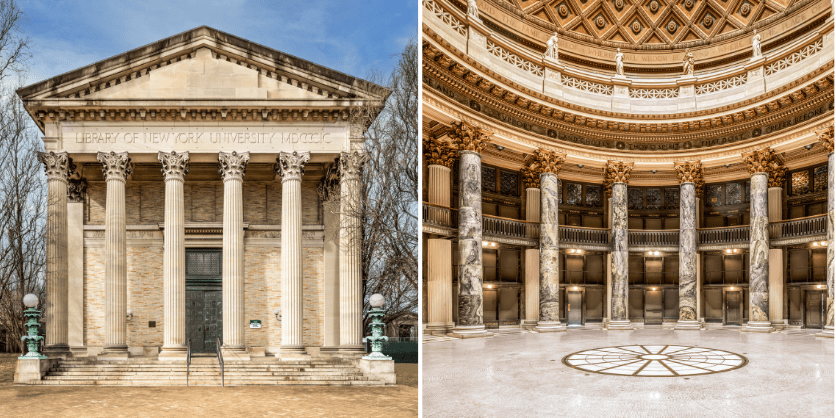
In the Bronx, the Gould Memorial Library stands as one of New York City’s most architecturally significant academic landmarks that can be found within the beautiful grounds of Bronx Community College.
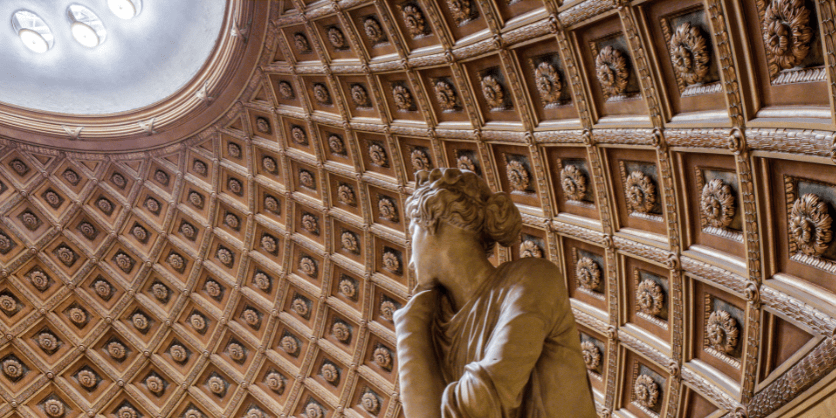
Designed by Stanford White and completed in 1900, the rotunda’s Roman Pantheon-inspired dome defines the building’s identity. The interior volume rises nearly 70 feet, crowned by intricate detailing and historic ornamentation that demand both reverence and technical precision.
Since the college was planning to reopen the space to the public for events, gatherings, and academic programming, the lighting system required complete reconsideration. The lighting project was taken on by Cline Bettridge Bernstein (CBB) Lighting Design, a certified Woman-owned Business Enterprise headquartered in Manhattan.
The challenge for CBB was not simply to increase brightness, but to restore architectural clarity, ensure code compliance, enable dimming control, and create a safe, visually comfortable environment that would allow visitors to fully experience the historic dome.
Before: Compromised Illumination
Originally, the rotunda relied on natural daylight from a central skylight. Over time, functional challenges led to the installation of a plaster ceiling beneath skylight, punctured by small openings. High-pressure sodium high-bay fixtures were suspended through these apertures to illuminate the space below.
The result was technically adequate, but visually problematic. High-pressure sodium sources produce a very warm correlated color temperature with low color rendering index (CRI). The rotunda’s architectural finishes appeared yellow and grayish, diminishing material richness and flattening the visual depth of the dome.
Operational limitations compounded the issue. These fixtures were not dimmable, restricting flexibility for events held during day and night. More critically, their restrike time made them unsuitable for emergency lighting compliance. In a public assembly space, this presented a safety and code concern.
As the school moved forward with reopening plans, it became clear that the lighting system needed to evolve. The solution had to be dimmable, code-compliant, visually comfortable, and capable of revealing, rather than obscuring, the building’s historic character.
Redesigning for Clarity and Compliance
The new lighting strategy designed by CBB centered on replacing the legacy high-pressure sodium fixtures with lighting manufacturer Meteor Lighting’s Whiz 2.0, a high-ceiling luminaire designed for large-volume applications. The challenge was substantial: a 70-foot mounting height demands significant lumen output, yet high-power LED sources can introduce visible pixelation and glare if not properly controlled.
In heritage architecture, glare is not a minor inconvenience. When visitors look upward to appreciating a dome, exposed LED emitters or harsh point sources disrupt the experience. Typical high-ceiling solutions rely on optical cutoff strategies to mitigate glare from common viewing angles. However, in a rotunda where occupants naturally look upward, additional control was required.
To address this, a custom frosted lens was developed specifically for the project. The frosted optic diffuses the LED source, softening brightness at the emitter level and eliminating visible pixelation. This custom lens approach allows occupants to perceive a smooth, consistent glow that complements the architectural rhythm of the ceiling.
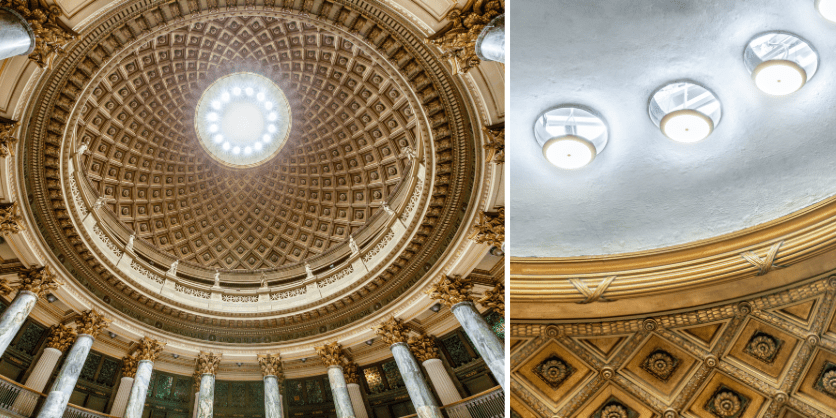
After: Balanced Illumination and Architectural Revival
With the Whiz 2.0 fixtures in place, the transformation is immediately evident. The dome now reads with clarity and dimensionality. Architectural details once dulled by sodium’s low CRI are rendered accurately, restoring material richness and tonal contrast. Reading areas benefit from improved visibility, while the upper dome is evenly activated without hotspots or harsh shadowing.
Dimming capability was a critical requirement for the library. The new Whiz 2.0 system supports smooth dimming, enabling the space to transition between different events during both the day and night. This flexibility was absent from the previous installation and is essential for a multifunctional assembly space.
Illuminating a 70′-high dome is fundamentally different from lighting conventional interior ceilings. Significant lumen packages are necessary to ensure adequate illuminance at floor level. However, output alone does not guarantee success. Without precise optical control, high-power fixtures risk producing excessive brightness contrast and glare.
Whiz 2.0 provided the output capacity required for the vertical volume, while the custom frosted lens refined the visual experience. This combination balanced intensity with comfort. Instead of overpowering the space, the lighting integrates seamlessly into the architectural composition.
Respecting History Through Technology
Historic renovation projects require restraint. Interventions must enhance functionality without competing visually with the architecture. In the Gould Memorial Library, Whiz 2.0 succeeds by restoring the prominence of the dome rather than drawing attention to the fixtures themselves.
The yellow cast and operational constraints of the previous system have been replaced by accurate color rendering, dimmable control, and glare-managed performance. The rotunda feels open and legible. Details once subdued by warm sodium tones are now clearly defined.
By combining high-output performance, precise glare mitigation and dimming solutions, the project establishes a model for future historic dome renovations. It illustrates that performance and preservation can coexist, and that thoughtful lighting design can restore not only brightness, but architectural integrity.
PROJECT CREDITS
Lighting Design – Cline Bettridge Bernstein (CBB) Lighting Design, Francesca Bettridge, FIES, IALD, LC – Principal; Nira Wattanachote, MIES, WELL AP, Senior Associate
Architect – Beyer Blinder Belle Architects & Planners LLP; Richard Southwick, FAIA, LEED AP, Partner; Graham Roscoe, AIA, LEED AP, Associate
Engineering – O&S Associates
General Contractor – TDX Construction Corp.
Lighting Controls Manufacturer – Lutron Electronics
Photo Credit: Elizabeth Leidel
Related articles
Meteor Lighting Redefines Performance Lighting with Atria Mark II