Does DarkSky Work for the Residential Market?
Since the DarkSky program launched in 2002 as the Fixture Seal of Approval (FSA), DarkSky International has made tweaks to its criteria over the years, but the most recent updates – announced in April – are notable because the program has expanded the list of categories to include Residential, Commercial, Pedestrian Comfort, and Wildlife-Tuned Luminaires.
According to an article published last month on Dark Sky International’s website, the world is getting brighter — and that’s not a good thing. Light pollution is increasing by 9.6% each year, which not only wastes energy but disrupts the nighttime environment for people, wildlife, and ecosystems. “When we overlight, fail to shield, or use the wrong color temperature, we contribute to this global crisis,” the organization said.
Consumer awareness of nighttime light pollution has grown substantially over the past eight or so years — which is great news for environmental and lighting professionals.
There was a time, maybe 15 years ago, when almost every full-line residential lighting manufacturer offered at least a few DarkSky-compliant fixtures. Sales were sluggish back then on the residential side because Dark Sky ordinances varied state to state and even among municipalities located just miles from one another. Typically the points of contention involved the amount of shielding permissible as well as specific color temperatures to be used. Since there were some variables in what qualified as Dark Sky-compliant in a particular area, many lighting residential manufacturers took their foot off the gas and waited for uniformity on a national level to be declared (which didn’t happen).
With recently renewed focus on the environment and light pollution’s effect on wildlife – particularly among the influential Gen Z demographic – residential lighting manufacturers appear to be once again interested in expanding their choices in DarkSky-compliant fixtures.
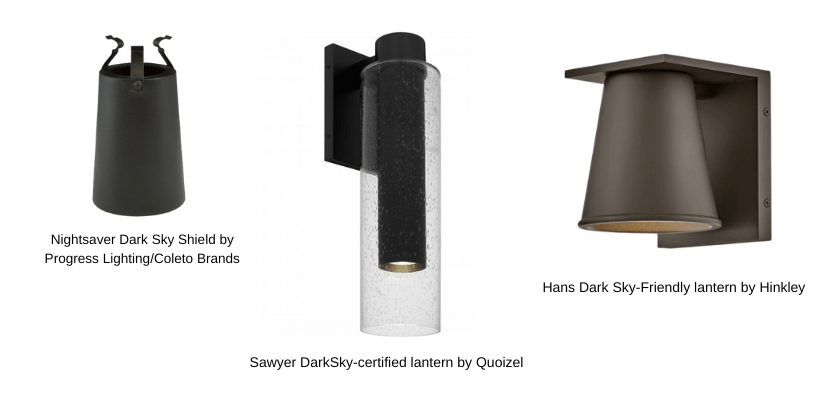
The caveat, I have learned from speaking with residential lighting manufacturers, has to do with the cost of having their products approved through DarkSky International’s certification program and undergoing what they say is a lengthy process. This explains the proliferation of lighting products marked “DarkSky-friendly” at recent trade shows. While not having the official DarkSky-compliant certification may be a non-negotiable for hospitality and commercial projects, for residential installations, DarkSky-friendly can be a suitable solution for eco-conscious homeowners.
Now that DarkSky International has issued new technical standards this spring, there might be even greater reluctance among decorative residential manufacturers to go through the DarkSky-compliant process.
What’s new
According to the new DarkSky standards, Residential luminaires must be under 1,000 lumens to prevent excessive brightness and light trespass; and Commercial lighting fixtures must limit high-angle light above 80 degrees from nadir to reduce glare and skyglow in public and commercial spaces.
The new updates to the DarkSky program make it “more accessible, more effective, and more closely aligned with [its] Five Principles for Responsible Outdoor Lighting at Night.”
The latest criteria was developed in collaboration with lighting engineers, designers, and experts in wildlife, ecology, and health.
“DarkSky International is not against the use of light at night — we support quality lighting,” says James Brigagliano, the DarkSky-Approved Program Manager. “The program proves that human-built environments can coexist with the nocturnal world while maintaining – and even improving – safety, performance, and design. It’s a ‘have your cake and eat it, too’ scenario. By designing or choosing DarkSky-Approved products, you invest in responsible light that protects the night.”
According to DarkSky International, the program now has “a clear set of guidelines and a streamlined application process so that manufacturers can quickly begin their path toward approval.”
For commercial projects and those desiring the DarkSky-approved seal, the official distinction will help products – and projects – stand out in the marketplace and demonstrate a commitment to the growing dark sky movement.
To learn more or begin the application process, visit the DarkSky-Approved Luminaires Program web page.
Related articles
How DarkSky partners with the National Audubon Society to promote Lights Out for the birds