
Bugs and Outdoor Lighting: The Effects of Artificial Light
May 21, 2024
By Jeffery Dross
Understanding why bugs prefer some artificial lights over others, like incandescent bulbs over LEDs, highlights the broader impact of our lighting choices on the environment, emphasizing the importance of considering wildlife and ecosystems when designing outdoor lighting.
I regularly read a newsletter about lighting, Light Now published by my friend David Shiller and his consulting organization, Lighting Solution Development. I urge you to do the same. (https://www.lightnowblog.com/ ) There is always great information and insight. Often times, it is research you didn’t know you need to know. In a recent post, Light Now pointed to new research on “why flying insects gather at artificial light.”
When LED was new I delivered hundreds of educational talks about this newfangled technology. As people learned more about it, better, more pointed questions would be posed. Through one of these queries, I was compelled to understand an insect’s attraction to light and laissez faire reaction to LED light. Why? I quickly learned that bugs are not actually attracted to light, but instead the infrared glow of a heated incandescent light bulb and the hot metal surroundings of the luminaire.
LED do not emit any light in the infrared spectrum and the low heat produced by LED barely warms the surrounding lighting fixture. If you were the moth’s version of SNL’s Stefon, pointing out the “hottest new club” in the neighborhood, it would not be located at the newly installed LED outdoor wall bracket. All of the “cool moths” are of course, still hang around the IR rich, incandescent lamps.
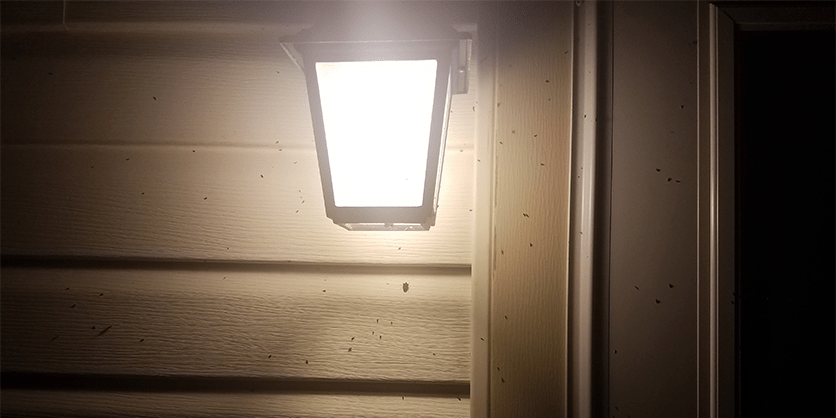
That explained the attraction, but not the kinetic action of the flying insects. This new report finds that when the bug “sees” the artificial light, it assumes it to be natural light. In their world, light is overhead and dark is below. The movement is the insect’s natural reaction to place the light in the right relative location, at their backside. Flying bugs are actually backing into the vertically installed luminaire and erratically circling the light with rises and dips.
I’ve written a few posts about sustainability and our responsibility as lighting professionals to “do the right thing” with light. The way we add light to the human environment has a tremendous impact on the animal population. This scientific research points out that even a bug as simple as a moth understands the proper position of the moon and the darkened land at night. Their hysteric dystonia is an effort to correct something which in their mind must be of their doing, not the peculiar humans who cohabit their neighborhood.
Artificial light has been around for as long as humans have employed fire and will remain for as long as humans exist. We could simply ignore the problem, but the natural balance of life will be tipped. When adding light to the nighttime, think about neighboring wildlife, plant life and aquatic life as well as the human client. While small, we shouldn’t forget bugs, either. Mother Nature will thank you.
More information available here