System Integrates Data From Bird Migration Forecasts to Dim Lights
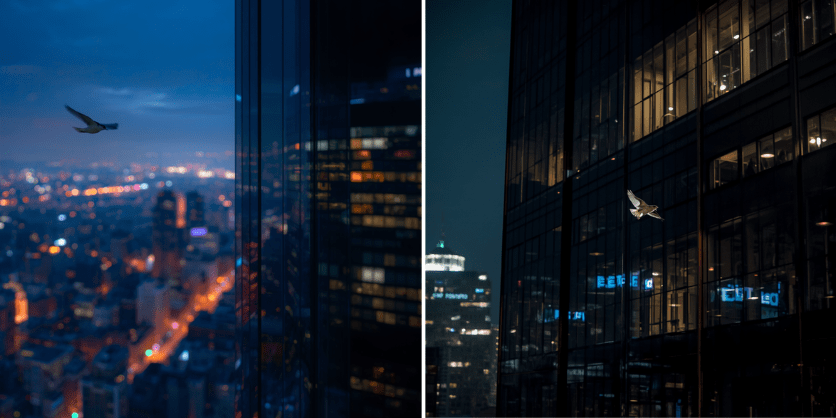
A specialized system uses BirdCast data to enable real-time lighting adjustments during peak migration events and reduce the number of birds colliding with buildings.
Editor’s Note: This article first appeared on the Cornell Lab of Ornithology website
Bright lights lead to the deaths of countless migrating birds each fall and spring, when millions stream across the night sky. Lights disorient birds and draws them closer to buildings where they collide with windows. A new AI technology protects them by automatically dimming lights at key moments.
Photometrics AI, a street-lighting optimization company, now includes bird migration forecasts as part of its lighting management platform. Cities using the platform will have access to an automated feature that dims lights when data from the Cornell Lab of Ornithology’s BirdCast migration monitoring platform signals big migration nights with high risks for window collisions.
“Street lighting represents one of the largest sources of artificial light at night in urban areas,” said Ari Isaak, founder of Photometrics AI. “By connecting our optimization platform to BirdCast’s real-time migration data, cities can take meaningful conservation action that runs automatically — not as a one-time campaign, but as an ongoing operational capability.”
BirdCast is a collaborative project among researchers at the Cornell Lab of Ornithology, Purdue University, University of Illinois Urbana-Champaign, and University of Massachusetts Amherst. It uses weather radar to detect the number of birds aloft and produces nightly forecasts of migration intensity – up to three days in advance – for the period approximately three hours after local sunset. BirdCast also provides data in a dashboard depicting intensity, flight direction, speed, altitude, and nightly and seasonal timing of nocturnal migration. The forecast data are also used to create alerts when migration intensity reaches significant levels.
Photometrics AI’s platform can receive these forecasts and use them to automatically adjust streetlights on nights when bird migration is heaviest. The system is designed to keep main roads, crosswalks, and other high-traffic areas safely lit, while dimming lights in residential zones and open spaces.
Photometrics AI’s software optimizes street lighting performance through networked lighting controls. The platform uses GIS-based target lighting layers and AI-driven analytics to determine optimal operating parameters for each luminaire, delivering energy savings while maintaining lighting standards compliance.
Because more than half of annual nocturnal bird migration over the contiguous U.S. occurs on just 10% of nights, targeted lighting reduction during peak events is a dynamic and high-impact conservation strategy. The biggest impact comes from reducing lights late at night and in the early morning, when birds fly at their lowest altitudes and humans need bright light the least.
“Dimming the lights when and where the streets aren’t being used makes a big difference for birds, but it makes almost no difference for us,” Isaak said. “This technology allows us to use lighting as effectively as possible so that we can live alongside the other creatures and species that we share the space with.”
Why It Matters
Each year, more than 1 billion birds die in the U.S. from collisions with buildings and windows. Bright city lights disorient migrating birds, pulling them toward urban areas and putting them in close proximity to structures where collisions can be deadly, including residential homes, corporate and university campuses, skyscrapers, greenhouses, and glass-enclosed bus stops.
The problem of light pollution is accelerating. According to research published in Science, night skies are growing brighter by nearly 10% each year. For many people, the night sky today is twice as bright as it was eight years ago. The brighter the sky, the greater the negative impacts on birds’ senses, and the fewer stars visible for orientation and navigation.
“Light pollution that conflicts with birds’ sensory capabilities, themselves, and with the visibility of stars that birds use as cues to orient and to navigate makes nocturnal migration significantly more difficult and dangerous for many species,” says Andrew Farnsworth, one of BirdCast’s scientists at the Cornell Lab of Ornithology. “Eliminating this conflict, whenever and wherever we can, is a conservation win.”
Related articles
AI as a Modern Approach to Street Lighting Design
Purple Rain & the Streetlight Industry’s Next Big Opportunity