2026 Commercial & Industrial Lighting Trends
With a volatile 2025 in the rearview mirror, here is one perspective of 2026 trends on the horizon.
By Cory Peterson
As the lighting industry adapts to changing market demands, flexibility and efficiency have become top priorities for architects, engineers, electrical contractors, and facility managers. The impact of tariffs, next-gen lighting upgrades, and the growth of AI have all directly influenced the technology and products shaping today’s lighting landscape.
2025 Tariff Retrospect & Looking Ahead
The impact of tariffs is diminishing as a news headline, but the effects are still being seen in the commercial and industrial lighting industry.
“2025 tariffs created a year of uncertainty. Because of this, contractors and facility managers focused on cost-conscious solutions and becoming more tactical in their businesses. Business value beyond pricing needs to be clearly communicated. As for tariffs in 2026, we expect the current rates to remain relatively unchanged, which will provide more stability for pricing and supply,” noted Neil Peterson, CEO of LED Lighting Supply.
The Rise of Next Generation Lighting
As we move forward with upgraded lighting, the focus shifts from lumens to lumens per watt. Today’s technology delivers far more light for each watt of energy used, allowing legacy 200-watt LED fixtures to be replaced with 100-watt LED fixtures while producing twice the amount of light.
Speaking to current industry trends, Neil shared, “We continue to see facilities and contractors increasingly upgrading to next-gen lighting solutions with our customers. This is driven by the strong impact these upgrades have on energy savings, improved performance, and maximized return on investment. For example, upgrading a first-gen fixture to a second-gen fixture can provide up to 70% savings on energy, resulting in a payback period of less than two years.”
Energy-Saving Trends
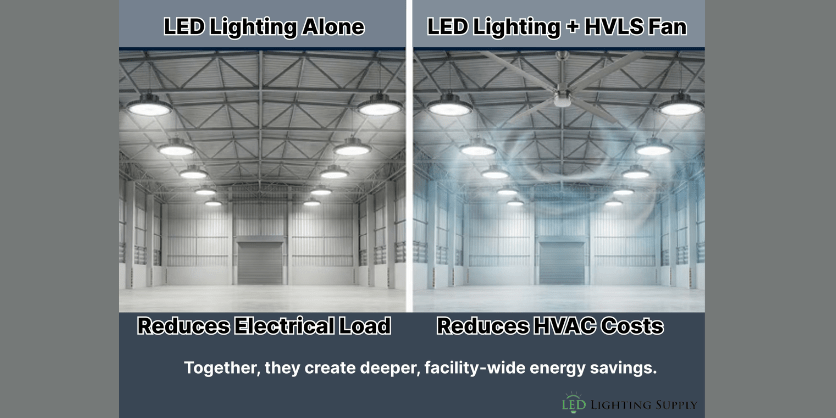
One example of where we’re seeing lighting projects intersect with other energy-savings projects is the use of high-volume low-speed fans, also known as HVLS fans. These fans optimize energy use with variable speed control, which reduces HVAC costs significantly while providing safe airflow. Neil stated, “We continue to see an increase in pairing industrial fans with lighting systems to further enhance energy savings and working conditions.”
Key Markets for 2026
The focus on value engineering in the lighting industry has brought several markets to consider this year in terms of product development, engineering, and broader energy-saving solutions. Value engineering ensures high-quality products that consumers can procure at a fair price, providing the best functional balance between cost, reliability, compliance, and performance.
In the lighting industry, this could involve providing pre-approved, code-compliant lighting packages that reduce labor and material costs for the facility. The Pulse of Lighting Report – based on feedback from approximately 200 manufacturers, lighting agents, and distribution personnel in 2025 – indicate industries that prioritize value engineering include:
• Warehousing
• Healthcare
• Data Centers
• Office Retrofits
• Municipal / State Government, and K-12
Specifiers in these fields continue to seek teams that prioritize personalized product quality and support. Manufacturers that focus on value engineering are better able to deliver products that ease the installation processes.
AI’s Impact on Efficiency and Productivity
Artificial intelligence (AI) in manufacturing is transforming how operations are managed. AI-powered systems allow facilities to program their preferences in terms of light levels or color temperature, working hours, and environmental behaviors. The result is improved productivity and precision due to the higher-quality light. Motion sensor lighting helps enhance energy savings by triggering high-quality illumination based on movement.
What to Expect: Growth & Rebates in 2026
Supporting our views, The Pulse of Lighting Report states product sales are projected to increase by 2.72% in Q1. This estimate is lower than many would have hoped due to concerns over 2026 local utility rebates, which drove the market in 2025. This year, we predict rebates to be a minor bonus and not a sales driver like they have been in the past. Rebates are declining as the market matures and political changes shift funds to other national priorities. Neil stated, “Unless it’s a big facility, in many cases rebates are now an afterthought and the reality is that rebates will continue phasing out due to federal funding shifts.”
We see clear evidence that growth is achievable for those who continue to evolve with these trends in the industry. Manufacturers should focus on products engineered for installation ease while adopting new technology that improves production efficiency. Facility managers should opt to work with seasoned product experts who will help spell out their investment and expected return. Contractors should stay resilient and agile as the industry continues to evolve with new project types such as data centers and large upgrade projects becoming more widespread across the country.
About the Author
Cory Peterson is Vice President of Marketing & Sales Operations at LED Lighting Supply where he focuses on improving customer experience and revenue operations. Cory writes about commercial & industrial lighting, along with topics important to contractors and facility managers.
LED Lighting Supply is a commercial, industrial, and sports project lighting, fan, and pole manufacturer and supplier that partners with customers to ensure the perfect solution for projects by providing exceptional product and post-purchase support. LED Lighting Supply’s Product Specialists can provide a lighting plan with product recommendations at no extra cost to ensure the requirements of your space are met.
References
Gordon, David, et al. “The Pulse of Lighting – Slow Q4. Rays of Hope for 2026?” US Lighting Trends. www.uslightingtrends.com/featured/the-pulse-of-lighting-slow-q4-rays-of-hope-for-2026/
LED Lighting Supply. (2026). LED Lighting Supply. https://www.ledlightingsupply.com/
Lighting Controls Academy. “LED-to-LED Upgrades: Emerging Well of Opportunity?” (2025). Lighting Controls Academy. https://lightingcontrolsacademy.org/led-to-led-upgrades-emerging-well-of-opportunity/