Lighting Defines Historic Courthouse Square
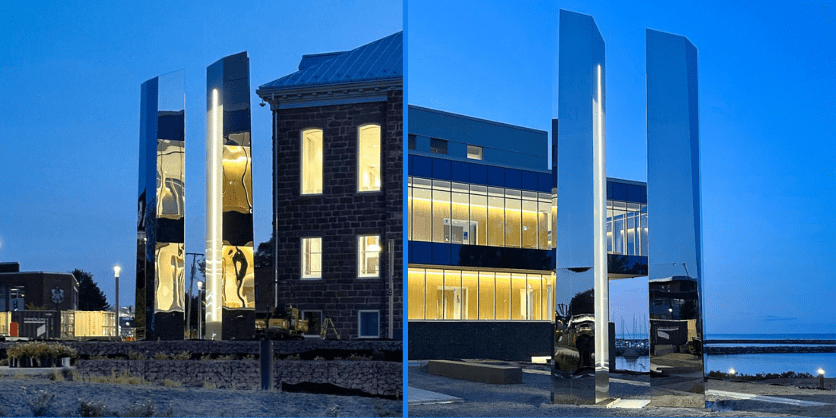
A new public art installation in a Québec courthouse square is highlighted by well-concealed lighting from Acclaim.
The renovation of the Roberval Courthouse (Palais de justice de Roberval) in Québec got off to a rough start with a fire destroying much of the historic building in May 2021. After the ashes were cleared, construction began anew on the structure. However, the project ultimately ended on a high note by winning the prestigious 2026 Prix d’excellence en architecture from the Order of Architects of Québec.
Last year, the renovation received additional attention and accolades with the installation of a magnificent art sculpture in the courthouse square known as “The Past of the Future.” Created and named by Canadian artist Louise deLorme, the sculpture has become a focal point of the renovation, being readily visible from inside the courthouse, as well as from pedestrian and bike paths around the square, and even from the lake.
The artwork features flexible integrated LED tube lighting from Acclaim Lighting that responds to ambient shifts in luminosity, creating a visual link between natural light, architecture, and the surrounding environment until the early hours of the morning.
The Historic Courthouse
The Roberval Courthouse is located in the heart of the historic downtown area. It houses the Superior Court and the Court of Québec, including civil, criminal, youth and small claims divisions.
A major challenge of the $116 million project was restoring the fragile century-old building while modernizing the judicial spaces and integrating a substantial expansion. The new design had to address rigid security requirements while still preserving the architectural integrity of the existing structure. Locally sourced granite, aluminum and glass were chosen for the exterior to bridge together the historic and contemporary structures.
The Artist’s Vision
“I aimed for this sculpture to create a contemplative and experiential atmosphere that would shift beautifully between day and night,” said deLorme. “The site itself offered me many possibilities to engage with the public and foster a sense of belonging and civic pride, aligning with the city’s cultural objectives.”
DeLorme intentionally chose two nearly identical steel elements for the installation that she believes symbolize the interaction that inherently takes place in the judicial process. Due to their proximity, they reflect each other, creating a reflection of a reflection and changing appearance depending on the angle from which they are viewed. The sheer size of the pieces is meant to offer a sense of strength and solidity, while immediately commanding attention.
“The Past of the Future is meant to explore themes of human perception, the continuity of time, and the transition between heritage and modern life,” added deLorme. “It treats each day as a continuous performance stretching from dawn to dusk.”
Each weighing in at an impressive 8,000 pounds, the custom stainless-steel sculptures, including the framework, stand over 30 feet high and measure more than 11′ x 4′ wide. They were fabricated with the help of Workshop in Victoriaville using a precise 1:20-scale model, and the metal was laser-cut, robotically and hand-soldered, and beautifully finished with brushed and polished surfaces.
The Perfect Luminous Finishing Touch
Choosing just the right light for the artwork was critical to the artist, who explained that light became part of the unified artistic concept that blended the two sculptural elements together. Rather than treating the light as a mere afterthought or utilitarian necessity, deLorme integrated the tubular LED lights into the design.
“At first the artist wanted to use some type of projector, but she then realized the effect would not have been as dramatic as the LED lights reflecting off the shiny surface,” said Patrick Nadjarians, director of marketing for Acclaim Lighting.
It was the Montréal-based lighting firm of EDP that introduced deLorme to the Acclaim FlexTube 4000 luminaire and sold her on the product’s flexibility, energy efficiency, and ease of installation. EDP is a prominent lighting, control and electrical products agency known for providing high-performance, energy-efficient solutions for commercial, architectural, institutional and industrial projects.
“It was the perfect product for this installation,” said Nadjarians. “The artist wanted something that was easy to conceal and could be embedded directly into the brushed surface of the 30′-high sculpture. Flex Tube proved ideal for that purpose because of its flexible low profile which makes it easy to install in a shallow space. And while flexibility was important for installation, even more appealing to the artist was the continuous line aspect and size of the flex tube.”
DeLorme was clear that the chosen lighting product had to be flexible, yet durable, due to the extreme weather conditions in the northern region of Québec that were exacerbated by the location of the sculpture on the banks of the immense basin of St-Jean.
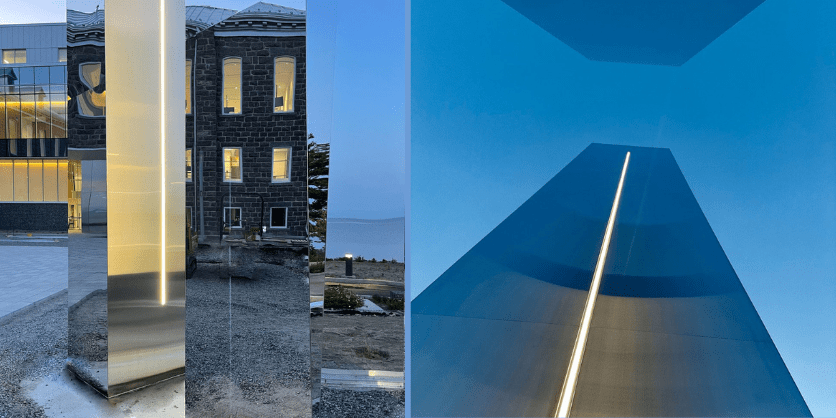
The Flex Tube product is encased in protective materials to offer superior weather resistance and mechanical protection. Yet, the side-emitting, outdoor-rated tube is fully bendable with a flexible silicone jacket that can bend to a diameter as small as 4.8 inches and can be cut every 4 inches.
IP68-rated, UV-coated, saltwater-resistant and submersible to 3 feet, Flex Tube Pixel SE has a highly durable, impact-resistant, PVC body that can be ordered to length to suit project requirements for nearly any customized lighting application.
“Its grazing illumination creates a seamless canvas of reflection on the facing surfaces of the other sculpture to further emphasize the artist’s vision to create a symbiotic relationship between the two structures,” said Nadjarians.
As for deLorme’s desire for an easy-to-stall lighting solution, the electrical connection for the Acclaim LED Fixture was completed in less than an hour.
A Real Crowd Pleaser
According to deLorme, the sculpture has received very complimentary feedback from the people of Roberval. She credits the lighting for adding to that positive experience.
“The light refracting through the polished surfaces offers the work multiple interpretive possibilities,” said deLorme. “Moving inside and around the sculptures, the perception shifts continuously, as does the relationship with light, turning the work into a physical experience even before a visual one. At night, an interplay of light and shadows highlights the transition between the two sculptures. The use of light as a sculptural material in this project invites a very different sensory experience.”
Related articles
Acclaim Lighting Brings Full‑Spectrum Control to Architectural Projects with Cylinder One Spectrum