LED Light Bulb Line Now Made in USA
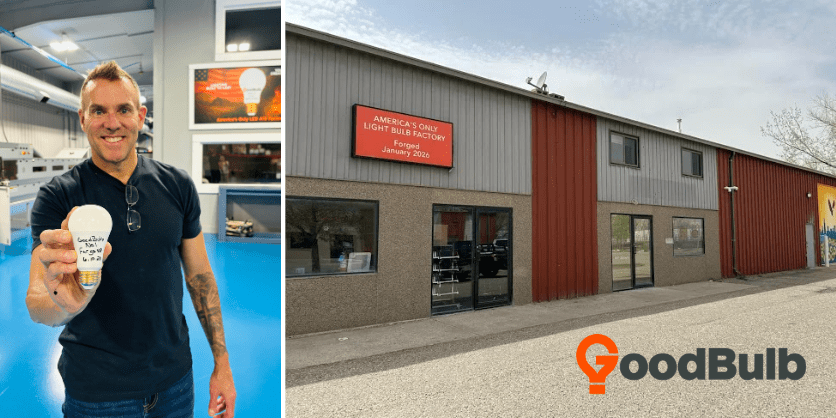
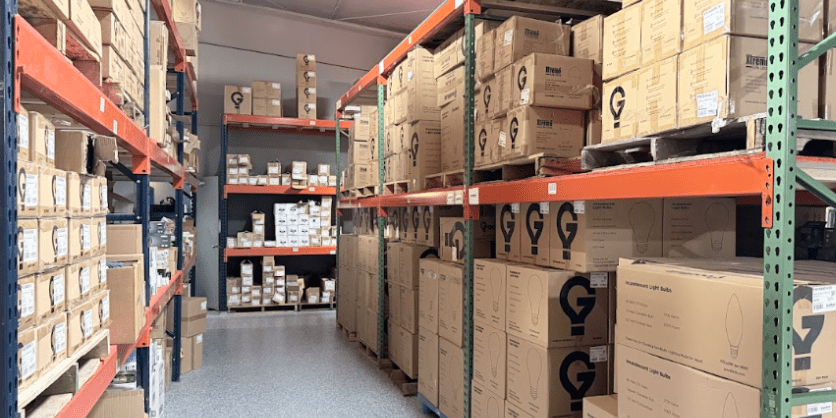
North Dakota-based GoodBulb is embracing technology by producing and packaging A19 LED light bulbs through a completely automated process.
Entrepreneur Tom Enright – who has 25 years of lighting experience in both ecommerce and brick-and-mortar – has announced his new light bulb factory in Fargo, North Dakota, has shipped its first American-made bulbs over July 4th weekend.
Enright founded GoodBulb in 2015, on top of an existing lighting business he owned in Fargo. Initially sourcing bulbs from overseas, he took the philanthropic approach of allocating a portion of GoodBulb sales to fund solar lanterns for families without reliable electricity and to aid disaster relief efforts.
Ultimately though, Enright’s long-range goal was to bring light bulb manufacturing back to America after major companies such as General Electric, Sylvania, and Philips ceased mass production of their light sources in the U.S. some time ago.
According to Enright, GoodBulb’s factory is the only one in the country producing A19 LED lamps. The milestone follows the more than a decade of domestic exits from LED lamp production, including the closures of the Sylvania plant in St. Marys, Pennsylvania and the GE plant in Bucyrus, Ohio, both of which once attempted domestic A19 LED manufacturing before shutting down.
“The major brands failed for two reasons,” Enright explained. “They tried to run the overseas model here, which is people-heavy, and that labor math never works in the United States — and they tried to do it in old plants built for incandescent and fluorescent, which is a completely different environment than LED requires. We did not try to beat cheap labor with cheaper labor. We beat it with automation.”
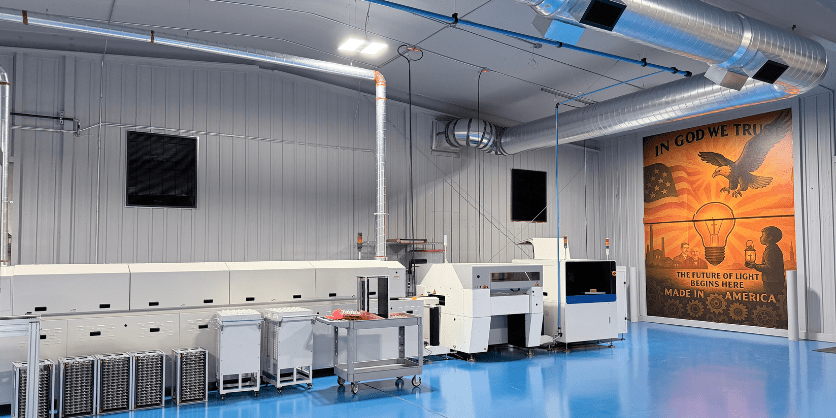
Rather than trying to reshore the labor-intensive production model used overseas, GoodBulb built custom automation to run the line from board to pallet. The Fargo facility manufactures its own LED circuit boards on an automated SMT line, produces and packages the finished lamps through custom automation, and palletizes with robotics. Enright describes it as a continuous board-to-pallet line. As such, GoodBulb can currently runs roughly 8,000 lamps per shift on equipment engineered for more than 10,000. Capacity can be scaled to more than 30,000 lamps per day across additional shifts, with three people per shift.
The path to domestic manufacturing was not easy; it took eight years to reach this point. The hardest part was environmental control, holding the temperature, humidity, and static tolerances that consistent LED output requires, in a purpose-built facility rather than a retrofitted one. In all, three adjacent buildings were combined into a single sealed and climate-controlled plant.
According to a statement from the company, the A19 line is available in a range of color temperatures from 2700K to 5000K at 90 CRI, in dimmable and non-dimmable versions plus a colored A19 line. The company is pursuing ETL certification and formal domestic-content qualification; the latter aimed at customers with domestic-sourcing requirements on government and institutional projects, a segment with few or no compliant A19 LED options today.
The A19 line is just the beginning. “This is the first line, not the last,” Enright said. “The process is documented and repeatable. We are already working toward a second product line, and it is a significant one for the commercial market.” The company declined to name the product but indicated it would carry domestic-content credentials from launch.
GoodBulb frames domestic lamp production as more than a marketing position. “Light bulbs are part of our nation’s critical infrastructure,” Enright said. “A country should be able to make something as fundamental as its own light. We shouldn’t depend on anyone else to keep the lights on.”