Energy Codes, Local Laws & the Essential Role of Lighting Control Systems

By Michael Jouaneh, LEEP AP, WELL Faculty
Energy codes and Building Performance Standards (BPS) establish minimum energy performance requirements while also shaping design and specification decisions, especially regarding lighting and lighting control. In the era of ultra-efficient LEDs, focusing on lighting control systems as a key strategy for achieving compliance might seem paradoxical.
In fact, from 2010 to 2022, lighting energy data from the International Energy Agency (IEA) shows that global lighting electricity use was basically flat. But new building and renovation projects are on the upswing, and LEDs enable more creative, intricate, layered lighting designs. So, while individual LED fixtures use less power than fluorescent ones, lighting use and net energy consumption are expected to keep growing, rather than decrease over time.
In addition, electricity rates are increasing quickly due to electrification, AI data centers, electric vehicles, and the reshoring of manufacturing. All of this is challenging grid operators to ensure they can provide all the energy states and municipalities need. By reducing energy use and lowering demand during peak periods, advanced lighting controls can help ease strain on the grid and defer or reduce the need for additional power generation. Building that additional infrastructure takes years to implement, requires regulatory buy-in, and involves massive investment.
National energy codes (IECC and ASHRAE 90.1), as well as local laws and building performance standards (BPS) are increasing mandates to reduce building energy use and/or carbon emissions. In this article, we’ll look at changes to the energy code and highlight local laws that portend changes on a broader scale and show how lighting control systems and strategies can make meaningful contributions to reducing building lighting energy use.
National energy codes (IECC and ASHRAE 90.1) set minimum standards for building energy performance and mandate the use of energy-efficient materials and systems to lower energy use, contribute to sustainability, and combat global climate change. They also drive the adoption of new technologies, materials, and construction practices that advance energy efficiency and sustainable building practices.
In most states, adhering to energy codes is a legal requirement for new construction and renovation projects, ensuring that those projects meet the established baseline standard for energy performance. Notably, some states adopt newer codes sooner than others, and others have no statewide energy code. Colorado, for instance, has no mandatory statewide energy code, but different jurisdictions like Denver and Boulder do require code compliance.
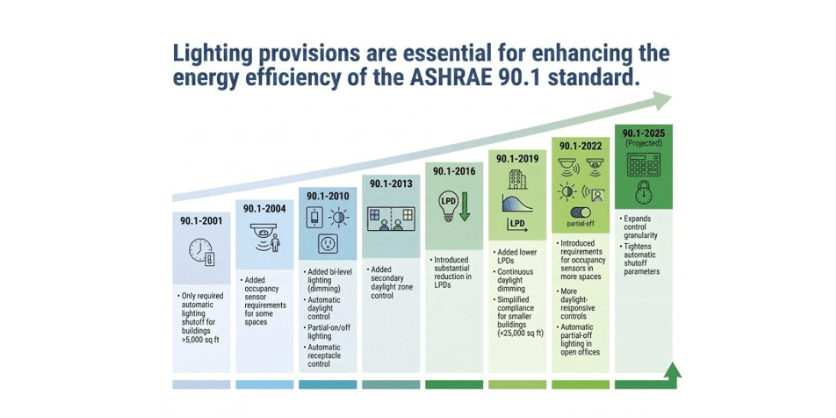
The national codes are updated roughly every 3 years, and each new version is more energy efficient than the previous one. Buildings designed to ASHRAE 90.1-2019, for example, are 4.7% more energy efficient than those designed to 90.1-2016 (or about 20% more efficient than buildings designed to the 90.1-2010 standard). Key lighting provisions are essential for enhancing the energy efficiency of the standard, and each iteration results in more efficient building codes:
• 90.1-2001 only required automatic lighting shutoff for buildings >5,000 sq ft
• 90.1-2004 added occupancy sensor requirements for some spaces
• 90.1-2010 added bi-level lighting (or dimming), automatic daylight control, partial-on/off lighting, and automatic receptacle control
• 90.1-2013 added secondary daylight zone control
• 90.1-2016 introduced a substantial reduction in LPDs
• 90.1-2019 added lower LPDs, continuous daylight dimming, and simplified compliance for smaller buildings (<25,000 sq ft)
• 90.1-2022 introduced requirements for occupancy sensors in more spaces, more daylight-responsive controls, and automatic partial-off lighting in open offices.
• 90.1-2025 expands control granularity and tightens automatic shutoff parameters
Local Laws and Building Performance Standards
State and local energy codes are typically based on the national model energy codes, which primarily apply to new construction and major renovations and do not address the performance, sustainability, and emissions goals of existing buildings. As a result, many states and local jurisdictions have developed additional requirements – Building Performance Standards (BPS) that define energy-use and/or emissions performance thresholds for existing buildings, often with compliance deadlines that phase-in over time, and impose financial penalties for noncompliance.
Rather than prescribing specific technologies, BPS requirements generally provide outcome-based performance targets allowing for a variety of pathways to compliance. They are currently mandatory in many jurisdictions across the country, but they differ widely. While some jurisdictions address on-site fossil fuel use through emissions-based performance thresholds or related electrification policies, the more immediate impact for electrical contractors comes from the operational nature of BPS compliance.
NYC Local Law 88, for example, requires many existing buildings to upgrade their installed lighting control systems to meet current energy code requirements. Compliance is mandatory as of May 1, 2025. The law targets energy efficiency at scale, applying to all buildings exceeding 25,000 gross square feet and requiring that lighting in commercial buildings and common areas of residential buildings be brought up to code. Sub-meters must be installed in all non-residential tenant spaces exceeding 5,000 square feet, and monthly statements showing amounts for electricity measured must be provided to tenants.
Similarly, NYC Local Law 97 is a BPS that establishes building-specific greenhouse gas emissions intensity caps for buildings over 25,000 sq ft as part of the city’s goal to reduce building emissions 40% by 2030 and 80% by 2050. Separately, NYC Local Law 95 requires many existing buildings to display a letter grade (A, B, C, D) based on their Energy Star Portfolio Manager score. Buildings that fail to submit annual benchmarking data receive an automatic “F” and exempted buildings receive an “N” grade. The goal is to reduce the emissions produced by the city’s largest buildings to net zero by 2050.
New York City has historically been an early adopter of progressive building policies, but the model is spreading, and standards like this are likely to be a preview of what’s coming elsewhere. As of early 2024, there were 13 U.S. cities with a building performance standard in place, including Seattle, Chula Vista, Denver, St. Louis, Montgomery County, Washington D.C., Cambridge, and Boston. Jurisdictions will take different approaches, but the underlying drivers – grid constraints, rising energy demand, and decarbonization goals – are increasingly global challenges looking for innovative solutions. In-depth information on BPS can be found here.
Lighting Control Systems Make an Immediate Impact
Smart lighting and control upgrades in existing buildings – such as LED retrofits, and networked lighting controls with occupancy sensing, daylight-responsive dimming, and scheduling – can deliver significant and immediate energy reductions with minimal disruption to workflow and productivity. When integrated with other systems, including HVAC and plug-load controls, lighting control strategies can simultaneously improve building performance and provide a more comfortable, human-centric space.
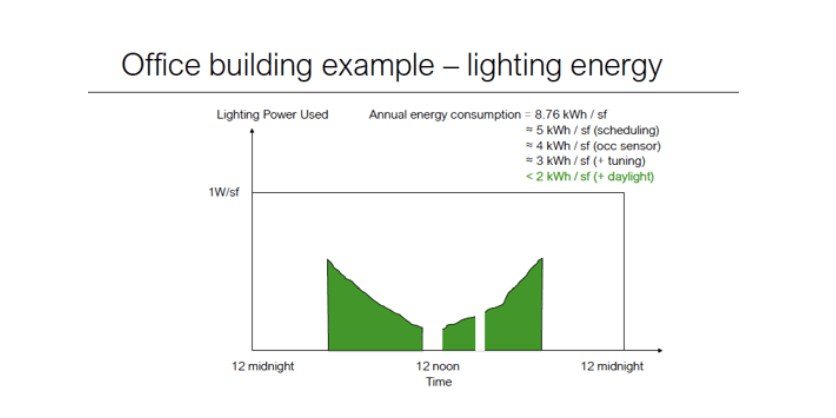
In a typical office building, layering four fundamental lighting control strategies – scheduling, occupancy/vacancy sensing, tuning, and daylight harvesting – can reduce annual lighting energy consumption by up to 70%, as shown by the following example:
If we start with a hypothetical office building* using 1.0 W/sf without lighting controls (lighting is on 24/7), the building will use 8.76 kWh/sf of lighting energy each year (i.e. 8,760 hours per year X 1.0 Watt/sf). The following steps illustrate savings that can be achieved with various lighting strategies:
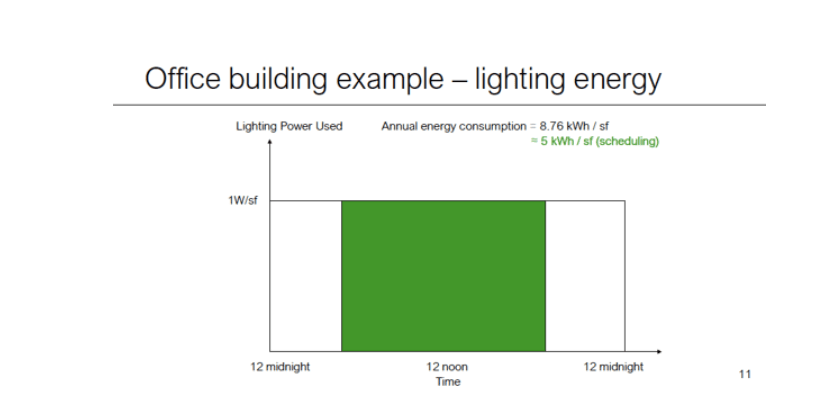
• Using an astronomical time clock to schedule a building lighting sweep during non-operating hours reduces the number to approximately 5 kWh/sf.
• Installing occupancy sensors that automatically turn lighting off in vacant areas can decrease lighting energy use to about 4 kWh/sf.
• Tuning the lights (reducing maximum lighting output) by 25% saves 25% lighting energy; lighting energy is now about 3 kWh/sf.
• Finally, daylight sensors can be used to reduce electric light levels when daylight is available, further reducing energy consumption to 2.3 kWh/sf
*This example is for illustrative purposes only; actual building performance will vary.
Designing for the Future
One challenge associated with code and BPS compliance is designing lighting control that stays up to date. Cost-benefit analyses often show that systems designed to meet only today’s targets can fall out of compliance well before the end of their expected service life. Since many BPS programs also become more stringent with each compliance cycle, advanced lighting control systems are often well worth the investment.
Consider the opportunities for higher building performance and deeper energy savings with smart, cloud-based systems that improve performance through software updates, reprogramming, or recommissioning without changes to installed hardware. The financial penalties for a system that does not meet ongoing BPS, or the cost of replacing the system before its end-of-life, can be the delta between installing a code-compliant lighting system and an advanced lighting control solution. Adaptable control architectures, flexible zoning, and integration-ready system infrastructure help mitigate long-term risk.
Energy codes continue to evolve, and Building Performance Standards (BPS) are becoming more widespread. Investing in robust lighting control solutions helps future-proof buildings by supporting compliance with today’s requirements while reducing energy use, lowering operating costs, improving building performance, managing peak demand, and providing the flexibility needed to support an increasingly stressed electric grid.
________________________________________________________________
About the author

Michael Jouaneh is the manager of sustainability and energy standards for Lutron Electronics Co., Inc. He is a frequent presenter at industry events such as Lightfair International and is active in the development of the top energy and green building codes/standards for the U.S.
Jouaneh is active with many organizations, including the Lighting Controls Association, ASHRAE, the California Energy Commission, the National Electrical Manufacturers Association, and the USGBC. He is a LEED AP, WELL AP, and WELL Faculty and holds a bachelor’s degree from the University of Colorado and an MBA from Drexel University.