
Can You Knit a Lighting Fixture? Foscarini Finds Out
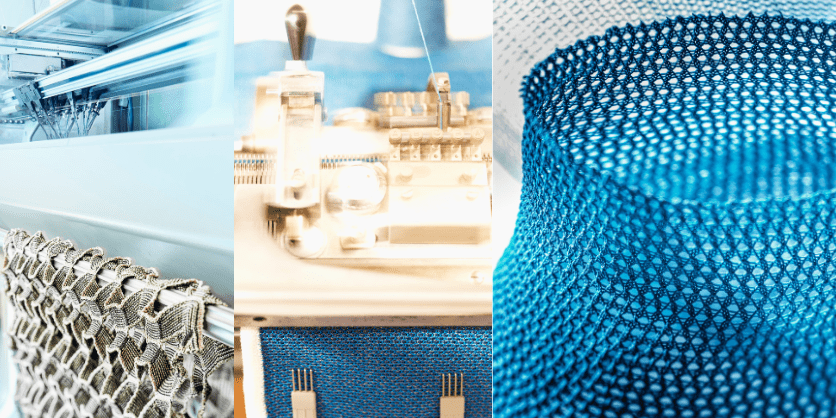
At the recent Milano Design Week 2026, Italian lighting manufacturer Foscarini presents a series of research projects that paired light with 3D knitting.
In the years when Euroluce does not take place – as was the case this year – renowned Italian lighting manufacturer Foscarini participates in the Interni FuoriSalone event, which is comprised of installations, performances, and the exploration of concepts and materials. The emphasis at FuoriSalone is on unexpected connections rather than offering finished, salable products.
At last month’s event, Foscarini entrusted two designers with different sensibilities and approaches – Jozeph Forakis and Lorenzo Palmeri – to explore the potential for 3D knitting when combined with light.
In the past, Forakis has experimented with the potential of knitting techniques to generate unusual volumes. He has also worked with “unconventional yarns” and with adapting machines typically used in the knitting process to new uses.
Palmeri, on the other hand, has borrowed from the types of workmanship used in fashion and applied them to design. He has concentrated on the capacity of the two-dimensional surfaces of fabric to become three-dimensional through refined cuts and other techniques that Foscarini describes as “almost a textile kirigami.”
According to the manufacturer, “Behind this research, there is also a reflection on the concept of soft tooling: the tool that gives form to objects is not a rigid mold, but a programmable loom, ready for infinite variations. The intelligence of weaving opens to a universe of chromatic alternation, variations of yarns, patterns and textures, leading to unexpected luminous effects.”
Noted Carlo Urbinati, president of Foscarini, “These projects stem from a value which is fundamental for us: freedom. Freedom, which sometimes means getting away from the norm, suspending function, exploring without pre-set outcomes. It is a gift we grant ourselves as a company. The attitude is that of serendipity: the fortunate and unexpected discovery that happens only to those who have the courage to search without knowing what they will find.”
Designer Jozeph Forakis explained the process in a booklet detailing the experiment:
“3D knitting is a technology that exists right under our noses, hidden in the high-performance mesh of a running shoe or a technical garment. Yet, textiles are among our oldest ‘industrially designed’ artifacts. I found myself captivated by the idea of a machine that doesn’t just cut or sew, but ‘grows’ a three-dimensional object in one continuous, seamless piece.”
He added, “I began to wonder: how far could this vocabulary of thread and three-dimensional form be pushed? Could we move beyond the ‘soft’ and find a way to give these woven volumes a skeletal structural integrity, a stiffness they weren’t meant to have?”
It was not an easy endeavor. “The journey has felt less like a studio project and more like the work of a mad scientist,” Forakis said. “I’ve spent years pushing different suppliers and technicians to the limits of what their looms, and patience, could endure. But in between these breaking points, where the material simply wouldn’t go further, is where we made some of our most interesting discoveries.”
Fortunately, a solution was found. “It was precisely when we hit what seemed a definitive dead-end that I reached out to Fabrizio and Luca at TexTech. Their expertise – and willingness – became the catalyst needed to unravel the mystery of how to engineer tension and structure in ways that begin to approach my original vision, and which seem fundamentally new to the knitting industry itself,” Forakis stated.
“In this installation with Foscarini, we aren’t presenting a finished product, but a chapter of an ongoing research. These sculptural forms and textures are a testing ground for the play of light and shadow. To me, the beauty of lighting design is a delicate game: the functional need to capture and contain a living energy, balanced by the emotional desire to celebrate it,” Forakis said.
He added, “When light is introduced to these 3D knits, something unexpected happens. It is no longer just a surface; the light is filtered, diffused, and ‘sculpted’ by the density of the weave. The object becomes a breathing volume that defines the space around it. This process has expanded my vocabulary as a designer. It has taught me that even the most ancient techniques – the simple act of interlacing a thread – can still surprise us if we have the patience to listen to what the material is trying to say.”
Related articles
Foscarini Lamps Receive Stylish Interpretation to Delight of Architectural Lighting Fans