The Distributor Self-Sufficiency Shift

Training solves the spec question, whether the trainer is human or AI. It does not solve the commissioning question.
By Bruno H. Silva, LC, CLCP
A veteran manufacturer rep wrote in Electrical Trends in August about where distributor profitability has gone. Distributor profitability used to run on a simple premise: more stock moved meant more profit made. That premise has been eroding for years, pressured by inventory carrying costs, tariffs, rebate targets that can crowd out margin as a priority and manufacturers increasingly selling direct to general contractors and EPCs (engineering, procurement, and construction firms) on larger jobs. The piece leaves the question open rather than resolving it; is this evolution or a shorter-term shift? And what happens to distributors that step back from stock and to manufacturers that bypass the channel? Offering one observation as a partial answer, the distributor he opened with kept growing long after its founder died by holding to his approach, a reasonable profit and service that beats most competitors.
Two answers to that open question have appeared in Electrical Trends coverage this year from two very different directions. Sonepar’s Lighting Academy has put 94 associates through at least one of its four training modules, a program Sonepar runs with Acuity Brands as a partner, and Sonepar reports roughly 28 associates across its U.S. companies who hold the NCQLP Lighting Certified credential. That is a human capital bet: build product and application knowledge in people. IDEA, meanwhile, has been promoting Nudge, an AI sales assistant built on its Data Whispers analytics, and gave it a place on the agenda at its eBiz conference in Denver in late September. It works as a virtual sales coach and information resource, tailored to each distributor’s own sales data and product offering. That is the same bet, placed on software instead of people.
Both are real capabilities, and both are worth the investment. Neither is systems integration capability, and the gap between them and commissioning is wide enough to drive a truck through. A distributor with 94 associates through its Lighting Academy, or a sales team coached by Nudge, is better equipped to answer a spec question than either was a year ago. Neither is, by that fact alone, better equipped to commission the networked control system behind that spec. Reading a spec sheet correctly, whether the answer comes from a trained associate or an AI assistant, is not the same skill as commissioning a networked lighting control system after it ships. Matching a data field to a SKU is not the same skill as troubleshooting cross manufacturer protocol conflicts on a live jobsite six weeks after handover, when the general contractor is calling and the punch list has one line item that will not clear. Spec fluency and data fluency, human or automated, live in a classroom or a database.
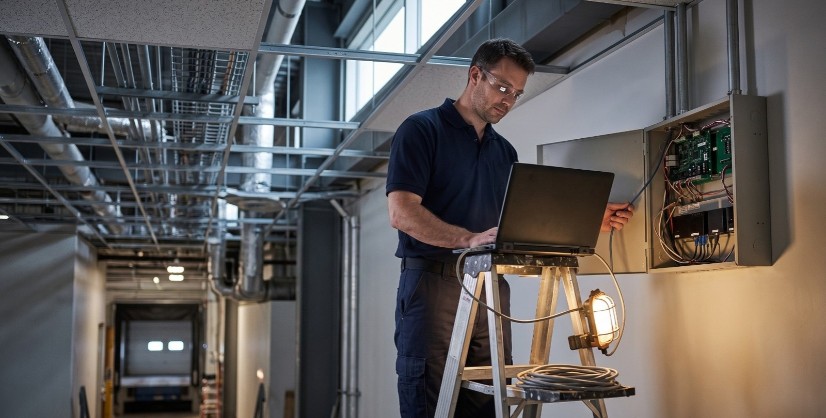
This is the part the current wave of distributor investment keeps skipping, whether the investment is a training academy or an AI product assistant. Building fluency does not automatically produce commissioning depth, any more than an agency’s historical product knowledge automatically produced it. The two capabilities have always been separated, and no channel party gets to claim the second one by virtue of having built the first. Brian Raegen, president of Access Electric Supply, made a related point in an Electrical Trends feature in August about the company’s move to employee ownership rather than a sale: the complex end of distribution, he said, is always going to be a people-to-people business, no matter how many tools get layered on top. He was talking about closing deals. The same logic holds for closing out a punch list.
The channel party that actually invests in commissioning depth, whether that is an agency choosing to specialize rather than spread thin, a distributor deciding field technical staff matter as much as counter staff and AI tools, or a manufacturer building direct support capacity, is the one that will hold the part of this business that training programs and clean data, human or automated, cannot replace. Everyone else is competing for the part that is already commoditizing.
________________________________________________________________________________

Bruno H. Silva, LC, CLCP, is an Electrical & Lighting Systems Integrator with four decades of experience spanning systems design, fabrication, controls integration, OEM manufacturing, and national sales leadership. He is the principal of TechBruno, LLC based in Saint Augustine, Florida.
Related articles