The Guarantee Outlives the Record

Energy codes require the lighting control record at acceptance. Nothing requires it again.
By Bruno H. Silva, CLCP
Under a performance contract, a lighting system stops being a design outcome and becomes a financial instrument. The energy service company has guaranteed a number, financed against it, and will be measured on it for a term that commonly runs 5, 10 or 15 years. Everyone else demobilizes at substantial completion. The ESCO stays.
What ASHRAE 90.1 already requires at acceptance
It is worth starting with what the industry already requires — because it is more than most people assume. Under ANSI/ASHRAE/IES Standard 90.1-2022 Section 9, where adopted, submittals and commissioning are mandatory on every compliance path, and alterations to existing lighting systems fall inside that scope. Section 9.7.3 requires that within 90 days of system acceptance the owner receives record documents showing the location, luminaire identifier, control, and circuiting for every piece of lighting equipment. It also requires operation and maintenance manuals that include a schedule for inspecting and recalibrating all lighting controls, and a complete narrative of how each control system is intended to operate, including recommended settings.
Commissioning captures the lighting control settings once
Section 9.9 goes further. Control devices and systems must be tested to verify that hardware and software are calibrated, adjusted, programmed, and in working condition. Time-switch programming must be documented for the owner, including weekday, weekend, and holiday schedules and all setup and preference settings. High-end trim documentation must show the initial and tuned set point and area for each control group and summarize the overall percentage of output or power reduction achieved through tuning. The energy performance of the lighting system must be commissioned, and the commissioning must be reported.
Read as a package, that is a genuine as-built record of how a lighting control system was configured on the day it was accepted. An ESCO carrying a savings guarantee could not ask for a better starting baseline.
The record is required once, but the guarantee lasts for years
The problem is not the record. The problem is that the record is required exactly once.
Nothing in Section 9 requires it to be regenerated. Not annually, not at the guarantee midpoint, not ever. The recalibration schedule must be delivered to the owner; nothing requires anyone to execute it. And the settings that were so carefully documented are, by design, the settings anyone can change: the DLC requires high-end trim to be field reconfigurable, which is what makes tuning useful and also what makes the documented baseline provisional. A 90-day snapshot is handed over, and then a 15-year obligation runs against it with no mechanism to detect that the two have diverged.
Configuration drift is the ordinary life of a control system
Configuration drift is not an exotic failure mode. It is the ordinary life of a control system after handover. Consider this routine sequence of events: A night cleaning crew complains about zones dropping out, so sensors get masked. High-end trim is raised during a punch list dispute and never lowered. Schedules are overridden for a tenant move-in and left overridden. Zones are reassigned during a churn and never re-documented. None of it registers as a product failure. None of it announces itself. It surfaces two years later as a savings shortfall, measured against a baseline document nobody has opened since the 90 deadline.
NLC V5.2 points toward repeatable configuration reporting
This is where the DesignLights Consortium’s updated Networked Lighting Controls Technical Requirements, NLC V5.2, effective August 3, become interesting. The revision recognizes systems that produce ANSI/NEMA C137.9-compliant configuration reports. That is precisely the artifact the code asks for in narrative form, rendered instead as something a machine can generate on demand and an auditor can compare against last year’s copy. A prose narrative of intended operation is written once. A standardized configuration report can be run every quarter for 15 years.
The capabilities that preserve the guarantee are still optional
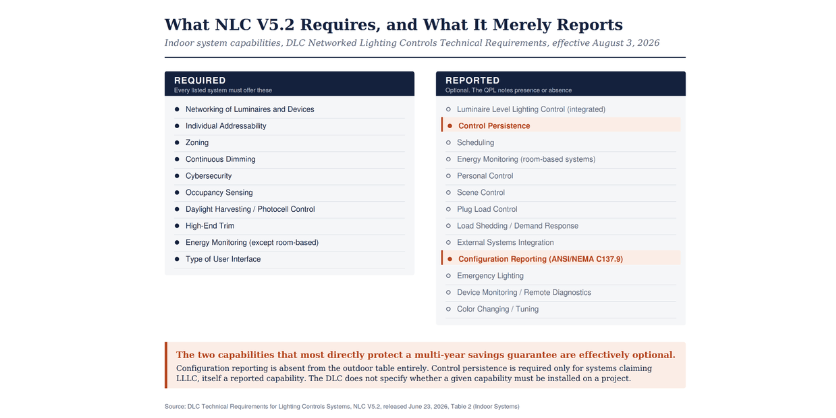
Here is the part that requires reading the requirements rather than the announcement. Configuration reporting is a reported capability, not a required one. It appears in the indoor capability table under Reported, and it does not appear in the outdoor table at all. Control persistence, which keeps occupancy sensing, daylight harvesting, and high-end trim executing at the edge device controller at room-level resolution or finer when communication with the next element up the topology is lost, is likewise reported rather than required, with one conditional exception: systems claiming luminaire level lighting control must include it, and LLLC is itself a reported capability. The two capabilities that would most directly carry a multi-year savings guarantee forward are, for practical purposes, both optional.
A QPL listing is not a project specification
The DLC is candid about this. The requirements state plainly that while the DLC requires systems to offer certain capabilities, it does not specify whether a particular capability must be installed on a project, and that project-specific requirements for rebates and incentives are determined by individual efficiency programs. That is a program qualification standard behaving exactly as designed. It is not a specification, and it was never intended to be one.
The warranty expires before the savings guarantee
The term mismatch compounds it. The DLC requires a minimum five-year warranty on all system components addressed by the requirements, with software, on-premises computer servers, and cloud service excluded, and that floor may be met through an optional purchased warranty extension. A performance contract can run two or three times as long. The configuration lives in the software layer the warranty does not cover, for years after the hardware warranty has expired.
Energy monitoring does not necessarily preserve guarantee-term evidence
Even the measurement floor deserves a closer look. Energy monitoring is required for indoor systems other than room-based ones, aligned to ASHRAE 90.1-2016 Section 8.4.3, with independent tracking of indoor lighting, outdoor lighting, and monitored receptacle circuits, tenant-level reporting, transmission to a building control system, and electronic sharing with authorized entities. The requirements name utility efficiency programs verifying energy savings as an example. On retention, though, they offer two alternative paths. One records data at least every 15 minutes, or on state change, reports it hourly through annually, and stores it for at least 24 months. The other requires only that, during the first year after original configuration, the system can report the preceding four weeks of interval data and daily interval data since configuration. A system qualifying under the second path meets the standard without ever holding two years of interval data, and the QPL does not indicate which path a given system took.
So, the picture resolves. The code requires the baseline once. The product standard makes the tool that would maintain it optional. The warranty expires before the guarantee does. And the data retention floor may be a fraction of the contract term. None of these is a defect in isolation. Each document is doing its own job competently within its own scope. The failure is in the seams between them.
The unresolved question is who closes the seams
Which raises the question the industry keeps circling without answering: whose job is it to close those seams?
Each project role stops short of guarantee stewardship
The lighting designer’s scope ends at closeout. The electrical contractor installs what the drawings show. The agent, carrying a line card that may run well past a hundred manufacturers, is structurally positioned to answer product questions rather than to author a measurement and verification sequence. The distributor fulfills. The commissioning agent verifies functional performance, produces the documentation the code requires, and demobilizes. The facility manager inherits a binder.
None of that is a failure of any individual party. Each is doing the work their scope defines, and doing it competently. The work that carries a 15-year guarantee simply sits outside every one of those scopes.
The missing function is systems integration across the guarantee term
That work is a systems integration function, and it is the capability the channel has not staffed. It requires reading a technical requirements document rather than a press release, translating optional capabilities into binding specification language, and writing handover requirements that survive the project team’s departure. In practice that means naming C137.9 configuration reporting and control persistence as required capabilities rather than assuming a QPL listing delivers them, specifying the retention path rather than assuming 24 months, and requiring an as-commissioned configuration report at acceptance and at defined intervals across the guarantee term rather than once at 90 days. It is additive to what the channel already does well. It displaces no one.
Codes, QPLs, and warranties do not close the guarantee gap
NLC V5.2 is a sound revision, and Section 9 of 90.1 asks for more documentation than most projects deliver. But a qualified products list is a procurement tool and a code is a minimum. Neither one writes the specification, and neither one tells an ESCO which optional capability its guarantee quietly depends on.
Somebody has to. On most projects, nobody does.
About the author
Bruno H. Silva, CLCP, is an Electrical & Lighting Systems Integrator with four decades of experience spanning systems design, fabrication, controls integration, OEM manufacturing, and national sales leadership. He is the Principal of TechBruno Consulting, based in Saint Augustine, Florida.