How to Turn Lighting Project Failures into Lessons
There are several things that need to go right for a lighting project to be successful. If any one of those things goes wrong, the project can be delayed or even completely derailed.
As Bruce Clark, managing principal for Illuminated Lighting Design and “Lighting Sherpa” at Kaleidolight Lighting Design, noted during a presentation at CEDIA Expo 2026 in Denver, “Most lighting failures aren’t events; they’re trajectories.” A small misalignment in design or procurement can compound as it passes through installation and controls – eventually revealing itself as an unfortunate symptom further down the line.
A structured lighting failure debrief helps teams trace those trajectories backward, identify the true origin point, and prevent the same issue from repeating. But it’s a tool that only works when designers, contractors, and integrators participate together.

Shared Pressure Zones Across the Project Timeline
The moment a problem becomes obvious is rarely the moment it began. Each project phase carries its own pressure points, and each discipline touches those points differently.
Designers establish performance criteria and fixture behavior. Integrators validate system compatibility. Contractors anticipate field conditions and installation realities. A mismatch in any of these early assumptions can ripple forward.
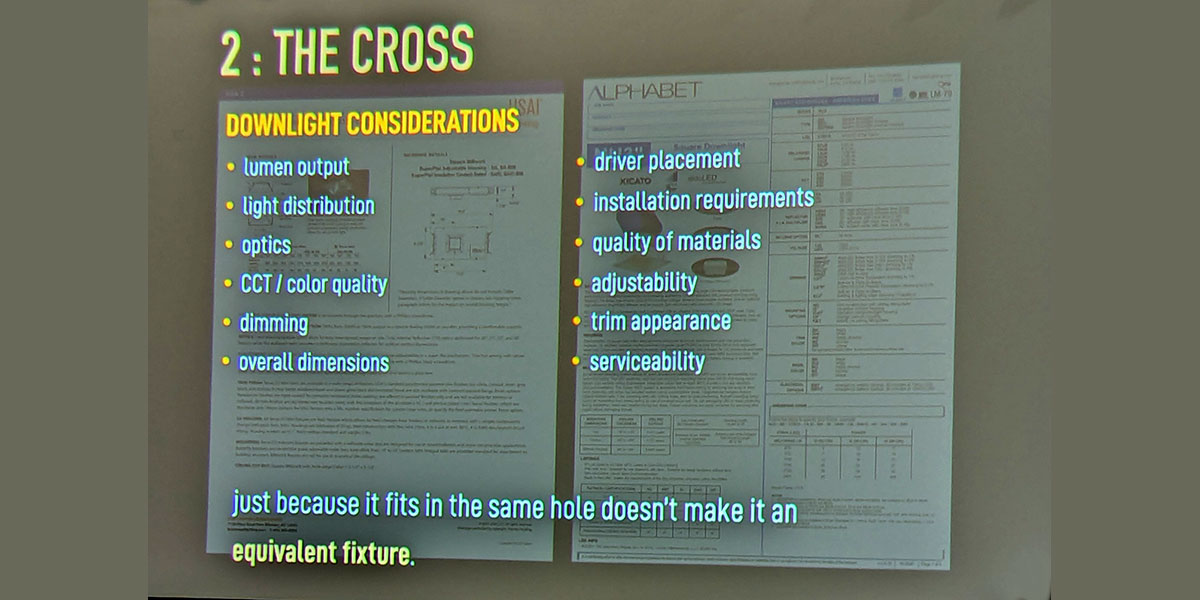
Substitutions are common, especially under cost or availability pressure. A product that appears equivalent on paper may behave differently in a system. Designers lose intended performance, integrators lose predictable behavior, and contractors inherit the downstream troubleshooting.
Unexpected framing changes, ceiling conflicts, or rushed sequencing can shift fixture placement or wiring paths. Even small deviations can alter system behavior later.
Fixtures and controls are increasingly interdependent. When they’re sourced separately or commissioned under time pressure, compatibility gaps surface. Integrators see the symptoms first, but the origin may trace back to design or procurement.
Commissioning is where everything becomes real. Undocumented adjustments, last‑minute changes, or incomplete system tuning can mask deeper issues. Without a debrief, these problems become tribal knowledge instead of institutional learning.
Common Failure Factor: Documentation Gaps
Across every stage of a lighting project, one factor consistently turns small issues into full‑scale failures: missing or incomplete documentation. When teams don’t understand why a decision matters, it becomes easier to change, reinterpret, or override it, Clark noted. Clear documentation preserves intent, context, and rationale.
Every revision to drawings, specifications, or sequencing plans should be annotated, dated, and shared so all parties know which version is current. Without that shared reference point, substitutions slip through, field adjustments compound, and commissioning teams inherit problems they didn’t create.
Strong documentation keeps the project aligned and prevents avoidable trajectories from forming.
The Lighting Failure Debrief
A lighting failure debrief is a structured review held after any deviation, not just catastrophic failures. It’s a short, focused conversation that traces a problem backward through the project timeline to find the true origin point. The goal is not to assign blame but to capture lessons that strengthen future work.
A debrief works best when everyone involved in the separate stages participate. Designers bring intent and documentation. Contractors bring field conditions and sequencing realities. Integrators bring system behavior and controls expertise. Together, they can see the full trajectory.
Start with what was observed. A fixture flickers. A control scene behaves inconsistently. A layout doesn’t match the drawings. Symptoms are usually discovered by contractors or integrators.
Then walk the issue back through design, procurement, installation, and controls. Designers clarify intent. Integrators explain expected system behavior. Contractors describe field conditions. The goal is to find the moment the trajectory began.
Document the origin point. Capture the specific action or assumption that created the trajectory. It may be a substitution, an undocumented adjustment, a misinterpreted spec, or a sequencing conflict. The origin point becomes the lesson.
Translate the lesson into a change. Update design standards. Adjust procurement guidelines. Add a commissioning checklist item. Flag recurring issues for cross‑team training. Preventive actions turn the debrief into value.
What to Ask
Clark outlined five questions that should be asked and what they establish in every lighting failure debrief:
- Intent: What were we aiming to do?
- Reality: What actually happened?
- Gap: Why/how did things diverge?
- Remedy: What can we do now?
- Refine: How can we avoid this next time?
Taking a structured approach to each debrief allows for the lessons to be readily translated to future projects – with the intent of identifying divergence before it becomes an issue.
Why Debriefs Matter More Now
Modern lighting systems make small misalignments more expensive. Tunable white, color‑changing, and adaptive systems require tighter coordination. Fixture‑controls integration means design decisions have field consequences. Supply‑chain volatility increases the likelihood of substitutions. DC lighting, PoE, and networked systems blur the lines between trades.
In this environment, debriefs aren’t optional. They’re a competitive advantage. Firms that institutionalize debriefs reduce callbacks, protect margins, and deliver more predictable results.