Lighting the Path to Resilient Data Center Performance
By Luis Valls, President & Co-CEO, Turtle
In the next five years, U.S. data centers may consume more electricity than the entire state of California. Across the electrical infrastructure landscape, one reality is clear: the grid was not designed for the demands of artificial intelligence, electrification, and continuous digital growth.
AI workloads, cloud platforms, and EV adoption have driven rapid expansion in data center construction and energy use. These facilities now account for an estimated 4% of total U.S. electricity consumption — that’s roughly 176 terawatt-hours (TWh) of power. To put it in perspective, that means U.S. data centers now consume more electricity each year than every home in California combined.
As the sector scales, every subsystem – from switchgear to lighting – must be engineered for reliability, efficiency, and integration.
The role of lighting in high-density data centers
While power systems often dominate the discussion, lighting is a critical but under-optimized part of data center infrastructure. Advanced LED systems and intelligent controls can cut lighting energy use by up to 40%, improve safety for maintenance teams, and contribute to overall facility heat reduction. This reduces the load on cooling systems and supports environmental performance targets.
Smart lighting platforms also integrate with building management systems, providing real-time visibility, automated dimming during low-traffic hours, and compliance with the latest energy codes.
Building a connected ecosystem
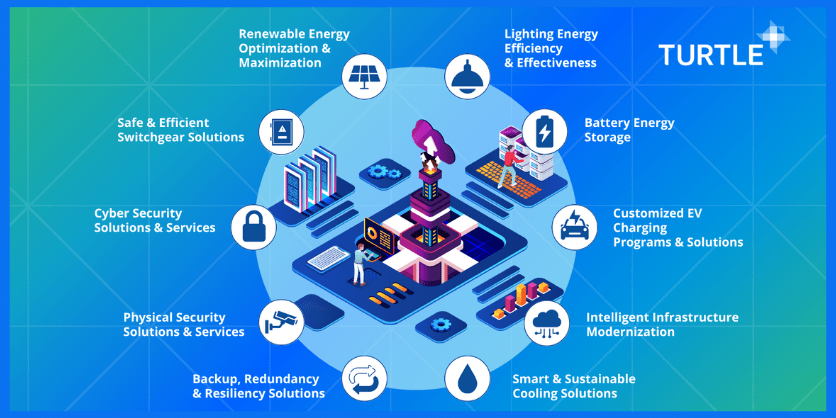
Optimizing lighting is most effective when it is part of a coordinated energy strategy that includes:
- Core electrical systems designed for continuous uptime like power conditioning, distribution, and switchgear engineered for scalability and minimal disruption.
- Lighting and controls integrated with environmental systems and coordinated with HVAC and monitoring platforms for responsive facility management.
- Real-time IT/OT visibility that provides unified insight into operational and environmental conditions for faster decision-making.
- Lifecycle support from site assessment through installation and ongoing optimization to adapt as capacity demands grow.
The biggest roadblock of all — seamless integration
Advanced technologies underperform when deployed in isolation. The key is to align lighting, power, and monitoring systems into a cohesive, scalable platform. This reduces commissioning delays, streamlines maintenance, and ensures that upgrades in one system improve the performance of others.
Organizations that align early, plan effectively, and partner with experienced solution providers can meet rising demand without delay or disruption. Not all partners are alike. To ensure you have the right one to help guide your journey, look for a partner with deep industry knowledge and technical expertise, proven innovation, and a track record of leading customers through times of transition.
How companies like Turtle can help
With over 102 years of electrical infrastructure experience, five generations of leadership, and a proven record across every industrial era, Turtle provides the insight required to deliver on today’s critical projects. Our independence allows us to act with speed and clarity, bringing agility to high-stakes energy programs where timing and coordination are essential. Each project we support draws from a connected ecosystem of disciplines, not isolated capabilities. That cohesion allows customers to reduce risk and execute without delay. Our approach combines:
- Lighting design and retrofit services that improve energy performance and qualify for incentives.
- Switchgear and backup systems configured for uninterrupted operation.
- Integrated monitoring and control that ties lighting, cooling, and power into a single operational view.
- On-site staging and kitting to keep installations on schedule and eliminate last-mile delays.
Our approach centers on radical collaboration. This means aligning every stakeholder – from owner to integrator – around executable solutions. Our TMRW Lab and field operations model this mindset by combining strategic planning, supply integration, and technical validation at every phase.
How we deliver
On recent data center projects, Turtle has delivered the switchgear infrastructure and power architecture required to support hyperscale deployment. Our teams work from design through installation to ensure that uptime, space utilization, and system scalability are optimized from day one. By integrating across OEMs, engineers, and project managers, we maintain performance goals while avoiding last-mile execution risks.
At a major new development on Manhattan’s West Side, Turtle supported one of the largest private microgrid systems ever deployed in New York City. The project included full energy system design and implementation to support residential, commercial, and transit operations within a 28-acre footprint. The result is a resilient energy model capable of powering mixed-use development through both peak demand and service interruptions.
At a major NYC airport, we partnered on the energy and infrastructure modernization during the redevelopment of Terminal B. Our work aligned FAA electrical specifications with evolving project constraints to deliver performance within a live operating environment.
Essential to your future
The decisions you make today on your data center approach will fundamentally impact your business outcomes and success for the next decade and beyond. Craft your strategy and choose your solution partner with these sky-high stakes in mind. The right solutions stack, blueprint, and provider can power your business to new heights and give you a long-term competitive edge.
Related articles
To reach Luis Valls